Most Affordable AI QA Tools for Engineering Teams in 2026
Engineering budgets are tight. QA headcount keeps climbing. And every escaped bug that hits production burns money, trust, and developer hours. So when your team starts shopping for AI QA tools, the price tag on the landing page is the first thing you check.
But sticker price tells you almost nothing about what a tool actually costs. A free plan that misses half your bugs will drain more money in production incidents than a paid tool that catches them before merge. A $12/seat tool that fires off constant false positives will eat your developers' afternoons. The real question is: what does each dollar of QA tooling actually buy you?
This guide breaks down every major AI QA tool by price tier, from genuinely free to mid-range, and then makes the case for why total cost of ownership matters more than any per-seat number. We also look at where autonomous AI QA fits in the picture for teams ready to stop stacking point tools and start replacing QA headcount.
Free Tier: What Zero Dollars Actually Gets You#
Free tools exist. They work. But each one makes tradeoffs that matter when your team grows past a handful of contributors.
SonarQube Community Edition#
SonarQube's Community Build is the most widely deployed free static analysis tool in the market. It covers 20+ languages and runs on your own infrastructure, which means no data leaves your network.
The catch: you lose branch analysis entirely (you can only scan your main branch), security rules are limited for several languages, and there is no portfolio-level reporting. For a side project or a small team that only cares about code smells on main, it works. For anything with multiple active branches and real security requirements, you will hit the ceiling fast.
Cost for 10-person team: $0 Key limitation: No branch analysis, limited security scanning
DeepSource Open Source Plan#
DeepSource shifted its free tier in March 2026 to an Open Source plan, meaning it is only available for open-source repositories. If your code is public, you get full static analysis, autofix, and code formatting at no cost.
If your code is private, this option is off the table.
Cost for 10-person team: $0 (open-source repos only) Key limitation: Private repositories excluded
Semgrep Free#
Semgrep offers the most capable free tier in the AI QA space right now. Teams with fewer than 10 monthly contributors get full SAST, SCA, and secrets detection at zero cost. The engine is fast, the custom rule syntax is approachable, and the GitHub App integration works well.
The catch: once you cross 10 contributors, pricing jumps to $40/contributor/month. That cliff is steep.
Cost for 10-person team: $0 (if exactly at the limit) Key limitation: Pricing cliff at 10+ contributors ($400/month overnight)
Snyk Free#
Snyk's free plan gives you limited vulnerability scans across code, dependencies, containers, and infrastructure-as-code. It is a good way to test whether Snyk's developer experience fits your workflow before committing budget.
But the scan limits are tight enough that most active teams will exhaust them within weeks. Think of it as a trial, not a long-term solution.
Cost for 10-person team: $0 Key limitation: Scan volume caps hit quickly for active repos
Free Tier Summary#
| Tool | Languages | Self-Hosted | Key Limitation |
|---|---|---|---|
| SonarQube Community | 20+ | Yes | No branch analysis |
| DeepSource OSS | 20+ | No | Open-source repos only |
| Semgrep Free | 30+ | No | Max 10 contributors |
| Snyk Free | 20+ | No | Limited scan volume |
Free tools cover the basics for small teams and open-source work. Once you have 10+ engineers working on private repos with active branches, you will need to pay for something.
Budget Tier: $12 to $25 per User per Month#
This is where most growing teams land. The tools in this range offer real AI capabilities, genuine automation, and enough features to meaningfully reduce manual QA work.
DeepSource Pro ($12/user/month)#
DeepSource Pro is the lowest-priced paid option in this space, and it punches above its weight. The platform delivers full static analysis with autofix across 20+ languages, and its sub-5% false positive rate means your developers spend time fixing real issues instead of triaging noise.
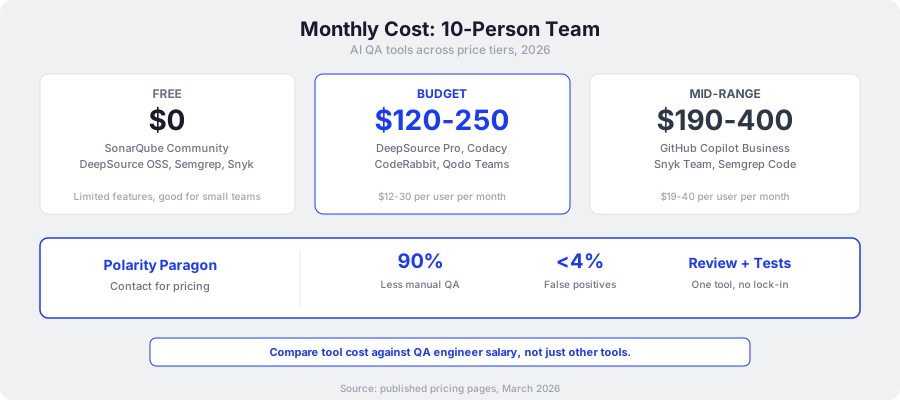
For a 10-person team, you are looking at $120/month. That buys you automated code quality checks on every PR, one-click patches for detected issues, and secrets detection for 30+ services. The ROI math works out quickly when you compare it to the hours your team currently spends on manual code review.
10-person team monthly cost: $120 Best for: Teams that want low-noise static analysis with strong autofix
CodeRabbit Lite and Pro ($12-24/dev/month)#
CodeRabbit is the most-installed AI code review app on GitHub, having processed 13M+ pull requests. The Lite plan at $12/dev gives you basic AI review features. The Pro plan at $24/dev opens up the full suite: unlimited AI reviews, 40+ integrated linters, SAST scanning, Jira/Linear integration, and analytics dashboards.
The platform focuses specifically on PR review. It is reactive (triggered when PRs open) and does not generate tests, run test suites, or act as a QA engineer. For teams that only need smarter PR reviews, it delivers. For teams that need broader QA coverage, you will stack it with other tools.
10-person team monthly cost: $120 (Lite) to $240 (Pro) Best for: GitHub/GitLab teams wanting thorough AI-powered PR reviews
Codacy ($18/user/month)#
Codacy's main selling point is language breadth. With 49+ supported languages, it covers more codebases out of the box than any other tool in this tier. You get static analysis, security scanning (SAST, SCA, secret detection), code duplication detection, and quality gates that block PRs failing your standards.
At $180/month for 10 developers, Codacy sits in the middle of the budget range. The platform has been around since 2012, so the analysis engine is mature and stable. Configuration can be complex for larger projects, and the AI capabilities are less advanced than newer competitors, but the language coverage makes up for it if your team works across many stacks.
10-person team monthly cost: $180 Best for: Polyglot teams needing broad language support in a single tool
Qodo Teams ($19-30/user/month)#
Qodo (formerly CodiumAI) occupies a unique position in this tier because it generates tests alongside code review. The platform includes Qodo Gen (IDE), Qodo Merge (PR review), and Qodo Cover (test generation), giving you 15+ agentic review workflows that cover bug detection, test coverage, documentation, and compliance.
At $19-30/user, Qodo costs more than DeepSource or CodeRabbit Lite, but it is the only budget-tier tool that produces test code. For teams that struggle with test coverage gaps, that capability alone can justify the price difference.
The credit system can be confusing, and costs can escalate at scale. Read the fine print on usage limits before committing.
10-person team monthly cost: $190-300 Best for: Teams that need automated test generation alongside code review
Budget Tier Comparison#
| Tool | Per-User Price | 10-Person Monthly | Primary Capability |
|---|---|---|---|
| DeepSource Pro | $12/user | $120 | Static analysis + autofix |
| CodeRabbit Lite | $12/dev | $120 | Basic AI PR review |
| Codacy | $18/user | $180 | Multi-language static analysis |
| CodeRabbit Pro | $24/dev | $240 | Full AI review + linters + SAST |
| Qodo Teams | $19-30/user | $190-300 | Code review + test generation |
Mid-Range Tier: $25 to $50 per Contributor per Month#
Mid-range tools cost more per seat, but each one brings something that budget tools lack. Whether that something justifies the premium depends on your codebase and your risk profile.
GitHub Copilot Business ($19/user/month)#
Copilot Business sits at the lower end of this tier, and its value proposition is unique: you get AI code generation and AI code review in one subscription. The agentic architecture (shipped March 2026) gathers cross-repo context and integrates CodeQL, ESLint, and PMD for security and quality checks. Reviews complete in under 30 seconds.
The limitation is platform lock-in. Copilot only works on GitHub. If you use GitLab or Bitbucket, this is not an option. And because each review consumes a "premium request," heavy usage can feel opaque in terms of actual cost.
10-person team monthly cost: $190 Best for: GitHub-only teams already using Copilot for code generation
Snyk Team ($25/dev/month, minimum 5 developers)#
Snyk Team bundles five security products into one platform: Code (SAST), Open Source (SCA), Container, IaC, and Cloud scanning. The AI engine (DeepCode) achieves 80% auto-fix accuracy, and the new Transitive AI Reachability feature determines whether vulnerabilities in deep dependencies are actually reachable in your code.
At $25/dev with a 5-developer minimum, the entry price is $125/month. For a 10-person team, that climbs to $250/month. The platform is security-focused rather than quality-focused, so you would still need a separate code review or testing tool for non-security QA.
10-person team monthly cost: $250 Best for: Security-focused teams needing unified vulnerability management
Semgrep Code ($40/contributor/month)#
Semgrep Code is the premium offering from the team behind the free tier. The headline feature is AI-powered auto-triage (Semgrep Assistant), which handles 60% of security triage automatically with 96% accuracy. The Memories feature learns from your team's past decisions to improve future triage.
At $40/contributor, a 10-person team pays $400/month. That is a significant jump from budget-tier tools, but the auto-triage capability can save hours per week for teams drowning in security alerts. The custom rule engine is also best-in-class if your team has the security expertise to write organization-specific policies.
10-person team monthly cost: $400 Best for: Security teams that need AI-powered triage to reduce alert fatigue
Open Source and Self-Hosted Alternatives#
For teams that want maximum control over their QA infrastructure and costs, self-hosting remains an option.
SonarQube Community Build is the most established choice. You run it on your own servers, keep all data internal, and pay nothing for the software itself. The hidden cost is the infrastructure and maintenance time: someone on your team will spend hours configuring, updating, and troubleshooting the deployment.
Kodus AI offers a self-hosted AI code review tool where you choose the underlying model. This gives you control over both cost and data residency, but you take on the operational burden of running ML infrastructure.
The honest tradeoff with self-hosting: you trade subscription costs for engineering time. If your team's time is cheap and your compliance requirements demand on-prem, self-hosting makes sense. If your engineers' hours are better spent shipping product, a managed SaaS tool will cost less in practice.
The TCO Argument: Why Sticker Price Misses the Point#
Here is where the math gets interesting.
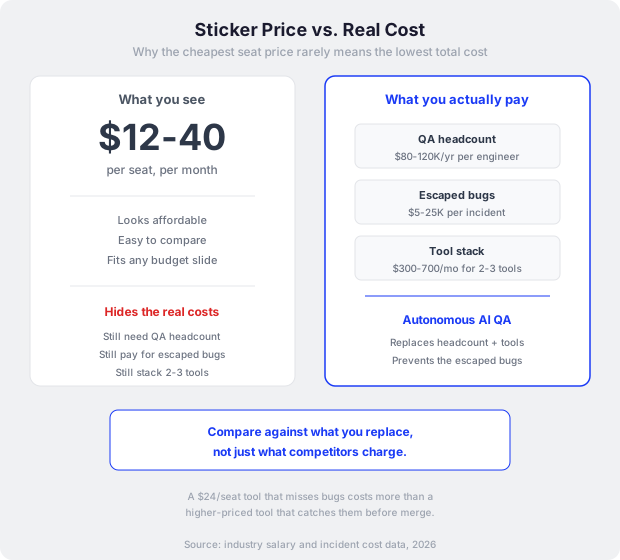
A mid-level QA engineer in the US costs $80,000 to $120,000 per year, which works out to roughly $6,700 to $10,000 per month in salary alone (before benefits, equipment, and management overhead). A 3-person QA team runs $240,000 to $360,000 annually.
Now consider what those QA engineers spend their time on:
- Manual test case creation and maintenance: 30-40% of QA time
- Running regression suites and triaging results: 20-30%
- Investigating and reproducing reported bugs: 15-20%
- Meetings, documentation, and coordination: 10-20%
Most of that work is exactly what autonomous AI QA tools are built to handle. A single AI QA agent that reduces manual QA effort by 90% could replace the equivalent output of multiple QA engineers.
Then factor in the cost of escaped bugs. Industry data consistently shows that bugs caught in production cost 5x to 25x more to fix than bugs caught during code review. A single production incident, complete with investigation time, hotfix development, deployment rollback, and customer communication, easily runs $5,000 to $25,000 or more.
A tool with a $24/user sticker price that misses bugs regularly will cost your team far more than a tool with a higher sticker price that catches them before merge.
Where Polarity Paragon Fits#
Polarity Paragon is an autonomous AI QA engineer, not a point tool. It combines multi-agent code review and test generation in a single platform, delivering:
- 90% reduction in manual QA effort across review, testing, and validation
- Sub-4% false positive rate, meaning developers spend time on real issues instead of triaging noise
- Tests-as-code output (Playwright/Appium), so your test artifacts live in your repo with full version control and zero vendor lock-in
- Multi-agent architecture that covers the full pre-merge quality pipeline rather than a single task
When you run the TCO math, the comparison shifts. You are comparing Paragon's pricing against the combined cost of 2-3 point tools ($300-700/month for a 10-person team) plus the QA headcount those tools still require. If one Paragon seat handles the work that previously required a full-time QA engineer and three separate subscriptions, the ROI compounds fast.
Contact Polarity for pricing, but think about it this way: even if Paragon costs more per seat than any budget-tier tool, the total cost to your organization drops when you factor in replaced headcount, eliminated tool sprawl, and fewer escaped production bugs.
Complete Pricing Reference Table#
| Tool | Tier | Per-User Price | 10-Person Monthly | Primary Use Case |
|---|---|---|---|---|
| SonarQube Community | Free | $0 | $0 | Basic static analysis (self-hosted) |
| DeepSource OSS | Free | $0 | $0 | Open-source repo quality |
| Semgrep Free | Free | $0 | $0 | SAST + SCA (<10 contributors) |
| Snyk Free | Free | $0 | $0 | Limited vulnerability scanning |
| DeepSource Pro | Budget | $12/user | $120 | Static analysis + autofix |
| CodeRabbit Lite | Budget | $12/dev | $120 | Basic AI PR review |
| Codacy | Budget | $18/user | $180 | Multi-language static analysis |
| GitHub Copilot Business | Mid-range | $19/user | $190 | Code gen + review (GitHub only) |
| Qodo Teams | Budget | $19-30/user | $190-300 | Review + test generation |
| CodeRabbit Pro | Budget | $24/dev | $240 | Full AI review suite |
| Snyk Team | Mid-range | $25/dev | $250 | Unified security platform |
| Semgrep Code | Mid-range | $40/contributor | $400 | SAST with AI auto-triage |
| Polarity Paragon | ROI-optimized | Contact | Contact | Autonomous AI QA engineer |
How to Choose the Right Tool for Your Budget#
If your budget is under $200/month: Start with Semgrep Free (if you have fewer than 10 contributors) or pair SonarQube Community with DeepSource Pro for $120/month. This gets you basic static analysis and autofix without breaking the bank.
If your budget is $200 to $500/month: CodeRabbit Pro at $240/month gives you the strongest AI PR review experience. Pair it with Qodo Teams if you also need automated test generation. Or go with Codacy if language coverage matters more than AI depth.
If your priority is maximizing ROI over minimizing sticker price: Look at Polarity Paragon. If your team currently has dedicated QA engineers and you are stacking 2-3 separate tools for code review, static analysis, and testing, an autonomous AI QA engineer that handles all of it in one platform will likely cost less in total, even at a higher per-seat price. Do the TCO math for your specific team before defaulting to the cheapest per-seat option.
For security-focused teams: Snyk Team or Semgrep Code are the strongest options. Budget-tier tools cover code quality well but are weaker on vulnerability management and compliance reporting.
For open-source projects: DeepSource Open Source plus Semgrep Free gives you a powerful zero-cost stack. Add SonarQube Community if you want self-hosted infrastructure scanning on top.
Frequently Asked Questions#
What is the most affordable AI QA tool in 2026?#
For teams under 10 contributors, Semgrep Free delivers the most capability at zero cost: full SAST, SCA, and secrets detection. For paid tools, DeepSource Pro at $12/user/month has the lowest per-seat price with strong autofix and a sub-5% false positive rate.
Are free AI QA tools good enough for production use?#
Free tiers work well for small teams and open-source projects. Once your team grows past 10 engineers or you need branch analysis, advanced security rules, and team management features, free plans become limiting. Most production engineering teams will outgrow free tiers within their first year.
How does total cost of ownership change the affordability picture?#
Significantly. A tool at $24/user/month that catches 90% of bugs before production saves more money than a free tool that lets issues slip to production at $5,000 to $25,000 per incident. Factor in the cost of manual QA headcount ($80K-120K/year per engineer), deployment rollbacks, and developer time spent triaging false positives. The cheapest seat price rarely translates to the lowest total cost.
Which tools offer open-source or self-hosted options?#
SonarQube Community Edition is the most established self-hosted option with 20+ language support. DeepSource offers free analysis for open-source repositories. Semgrep's core scanning engine is open source. Kodus AI provides a self-hosted AI code review option where you control the model.
Can an autonomous AI QA tool replace manual QA headcount?#
Polarity Paragon delivers a 90% reduction in manual QA effort. For teams currently employing multiple QA engineers and subscribing to several point tools, a single autonomous AI QA platform can absorb the workload of both the human headcount and the tool stack. The savings compound when you account for replaced salaries, eliminated subscriptions, and reduced production incident costs.