How to Cut Your PR Review Cycle Time in Half with AI QA
You open a pull request at 10 a.m. By 3 p.m., zero feedback. The next morning someone leaves three comments, you fix two, and then you wait again. By the time the PR merges, you have context-switched four times, started a completely different feature, and can barely recall the reasoning behind your own decisions.
Every team I have talked to knows this pattern. PR review cycle time, the total elapsed time from opening a pull request to merging it, is one of the most expensive hidden costs in software engineering. The DORA research program has shown, year after year, that shorter lead times correlate with higher-performing engineering organizations. Deployment frequency, developer satisfaction, change failure rate: they all improve when code moves through review faster.
Here is the good part. AI QA tools have reached a point where they can compress every phase of the review cycle, from first feedback to final merge. Teams adopting these tools are reporting 50% or greater reductions in total cycle time. This post breaks down exactly where time gets lost during PR review, how specific AI QA tools address each bottleneck, and what the numbers actually look like before and after adoption.
Where Time Actually Gets Lost in PR Review#
Before you can speed anything up, you need to understand where the delays live. PR review cycle time is almost never one big wait. It is a chain of smaller delays that stack on top of each other.
1. Waiting for the First Review#
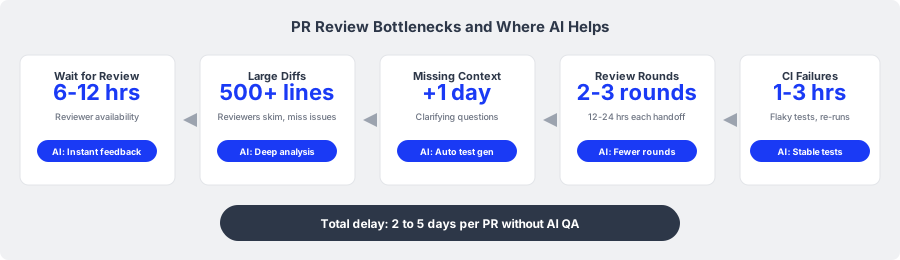
The single largest delay for most teams is time-to-first-review: the gap between opening a PR and receiving any feedback. Studies of GitHub activity data show the median time-to-first-review across open source projects lands between 4 and 24 hours. Internal teams often do better, but many engineering organizations still report 6 to 12 hour waits.
The root cause is simple: reviewer availability. The senior engineers with the most context are also the busiest people on the team. They are in meetings, handling incidents, or deep in their own code. Your PR sits in a queue behind their other priorities.
2. Large, Unfocused Diffs#
PRs that touch 500+ lines take exponentially longer to review. Reviewers skim instead of reading carefully, and the odds of a thorough review drop sharply. Google's internal research found that PRs under 100 lines received reviews 2x faster than those over 300 lines.
3. Missing Context#
A reviewer opens the diff and immediately asks: "Why was this approach chosen?" or "What does this affect downstream?" When test coverage, documentation, or a clear PR description is missing, reviewers spend their time investigating instead of reviewing. Each round of clarifying questions adds hours or days.
4. Back-and-Forth Cycles#
A reviewer leaves comments. The author responds and pushes fixes. The reviewer re-reviews. Each round typically adds 12 to 24 hours of latency because both people need to be available at the same time. The average PR goes through 1.5 to 2.5 review rounds before merging.
5. Test Failures Blocking Merge#
Even after human review is complete, CI failures can stall the merge. Flaky tests are especially destructive: they force re-runs, create uncertainty about whether a failure is real, and sometimes require manual investigation. Teams report that flaky tests add an average of 1 to 3 hours to cycle time per affected PR.
How AI QA Tools Attack Each Bottleneck#
AI QA does more than automate review. Different tools target different phases of the cycle. Here is how they map to the bottlenecks above.
Instant First-Pass Feedback#
The most immediate win from AI QA is killing the wait for first review. Tools like CodeRabbit deliver automated PR comments within seconds of opening a pull request. They provide line-by-line feedback on bugs, style issues, and potential problems. CodeRabbit has processed over 13 million PRs, so its pattern library is extensive. GitHub Copilot Code Review operates in the same space, generating feedback in under 30 seconds.
This does replace the need to wait for a human to do the easy part. By the time a senior engineer looks at the PR, the author has already fixed the obvious issues. The human review starts at a higher baseline.
Deep, Context-Aware Analysis#
Instant comments on syntax and style are just the starting point. The harder problem is understanding what a change does across the full codebase, identifying where it might break things, and generating meaningful test coverage for the new behavior.
Polarity's Paragon operates here as an autonomous, multi-agent AI QA engineer. Instead of just flagging style violations, Paragon runs 8 parallel agents that analyze the PR in full context, generate tests-as-code output, and validate behavior against the existing codebase. On ReviewBenchLite, Paragon achieves 81.2% accuracy with a false positive rate under 4%. That means reviewers spend their time on real issues instead of chasing noise.
The practical result: teams using Paragon report a 90% reduction in manual QA effort. That translates directly into fewer review rounds, because the AI catches functional issues that would otherwise require a human to find, comment on, and then re-review after the author fixes them.
Reducing Review Rounds#
Every review round that AI eliminates saves 12 to 24 hours. When AI QA catches a null pointer exception, a missing edge case, or a regression risk on the first pass, the author fixes it before requesting human review. The human reviewer sees cleaner code and raises fewer concerns.
This compresses the typical 2 to 3 round review cycle down to 1 or 1.5 rounds. On a per-PR basis, that is roughly one full day saved.
Stabilizing CI and Eliminating Flaky Tests#
AI QA tools that generate deterministic, well-scoped tests reduce the flaky test problem at its source. Paragon's tests-as-code output is stable, reproducible, and focused on actual behavioral changes rather than brittle end-to-end assertions. Teams that replace fragile test suites with AI-generated targeted tests see their CI pass rates climb and their merge-blocking failures drop.
Accelerating DORA Metrics#
For engineering leaders tracking DORA metrics (deployment frequency, lead time for changes, change failure rate, time to restore service), PR cycle time is a direct input to lead time. Tools like LinearB and Sleuth give you visibility into these numbers, showing exactly where your bottlenecks sit. Combining DORA metric tracking with AI QA creates a feedback loop: you measure the bottleneck, deploy an AI tool to address it, and then measure the improvement.
Graphite takes a different approach to PR speed by enabling stacked PRs. Developers break large changes into small, dependent pull requests that can be reviewed and merged independently. This reduces diff size per review (directly addressing the large-diff bottleneck) while keeping the full change set coherent.
Real Metrics That Show the Difference#
Developers talk about "feeling faster," but engineering leaders need numbers. Here are the metrics that matter, and what AI QA actually moves.
Time-to-First-Review#
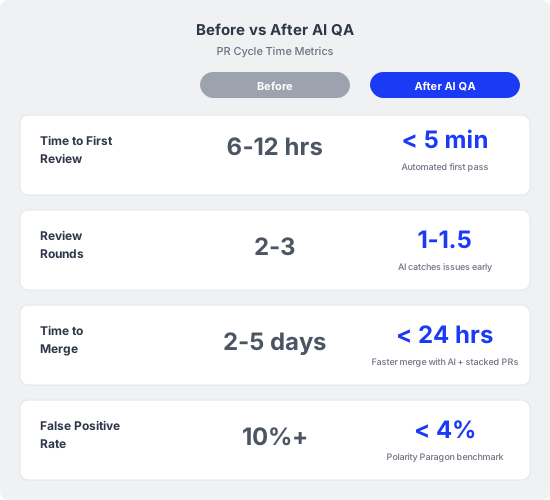
Before AI QA: 6 to 12 hours (median for most internal teams) After AI QA: Under 5 minutes for the automated first pass; human review within 2 to 4 hours (since the PR is already cleaner)
The automated first pass does double duty. It gives the author immediate feedback, and it signals to human reviewers that the PR has already been through an initial quality check.
Review Rounds Per PR#
Before AI QA: 2 to 3 rounds, each adding 12 to 24 hours After AI QA: 1 to 1.5 rounds, since AI catches functional issues on the first pass
This is where the "cut cycle time in half" claim becomes concrete. Removing one full review round from the average PR saves 12 to 24 hours. For a team merging 20 PRs per week, that is 240 to 480 hours of developer time recovered per month.
Time-to-Merge#
Before AI QA: 2 to 5 days for the average PR After AI QA: Under 24 hours for most PRs
Teams that combine AI QA (for quality), stacked PRs (for scope), and DORA metric tracking (for visibility) consistently report sub-day merge times.
False Positive Rate#
This metric determines whether developers trust the AI or ignore it. Once false positives exceed 10%, developers start treating AI comments the way they treat noisy linter warnings: by scrolling past them. Polarity Paragon's sub-4% false positive rate keeps developer trust high, and that trust is what sustains adoption over time.
Building a Workflow That Actually Works#
Dropping an AI QA tool into your CI pipeline and calling it done will underdeliver. The teams that see real results build intentional workflows around these tools.
Step 1: Measure Your Baseline#
Before changing anything, capture your current PR cycle time metrics. Use LinearB, Sleuth, or a simple query against your GitHub data. Track time-to-first-review, review rounds, and time-to-merge across your team for at least two weeks.
Step 2: Start with Automated First-Pass#
Deploy an AI QA tool that provides instant feedback on every PR. CodeRabbit and GitHub Copilot Code Review are both easy to set up and deliver immediate value by catching surface-level issues before a human reviewer looks at the code.
Step 3: Add Deep AI QA for Functional Coverage#
Layer in a tool like Polarity Paragon that goes beyond style and syntax. Paragon's multi-agent architecture analyzes PRs for functional correctness, generates test cases, and flags regressions, all with a false positive rate under 4%. This is what reduces review rounds, which is where the biggest time savings live.
Step 4: Optimize PR Size and Structure#
Use Graphite or a similar stacking tool to encourage smaller, focused PRs. Combine this with team agreements on maximum PR size. 200 to 300 lines is a good target.
Step 5: Track and Iterate#
Measure the same metrics you captured in Step 1. Compare week over week. Share the results with the team. When developers see their PRs merging in hours instead of days, adoption accelerates on its own.
Which Tool Does What#
Each tool in this space addresses a different piece of the PR review puzzle.
Polarity Paragon is the best fit for teams that need deep, functional QA with low false positives. Its 8 parallel agents, 81.2% accuracy on ReviewBenchLite, and tests-as-code output make it the strongest option for reducing review rounds and replacing manual QA. Best for teams where quality bottlenecks are the primary drag on cycle time.
CodeRabbit excels at instant PR feedback. It generates line-by-line comments within seconds, catching style issues, potential bugs, and documentation gaps across more than 13 million PRs processed. Best for teams that need to eliminate the time-to-first-review gap.
GitHub Copilot Code Review provides fast feedback (under 30 seconds) directly within the GitHub interface. Best for teams already committed to the GitHub and Copilot toolchain who want a low-friction addition.
LinearB and Sleuth are DORA metrics platforms that show you exactly where your cycle time gets spent. They surface the data you need to make informed decisions about which AI QA tools to deploy and where to focus.
Graphite addresses PR size and structure by enabling stacked PRs. Best for teams where large diffs are the primary bottleneck slowing down reviews.
The Developer Experience Angle#
Numbers matter for engineering leaders. For individual developers, what matters is how it feels to ship code. Getting useful feedback in minutes instead of waiting half a day changes the nature of the work. You stay in context. You fix issues while the code is still fresh in your head. You merge and move on.
Teams that have adopted AI QA consistently describe a shift in how they think about code review. It stops being a dreaded bottleneck and becomes a fast, predictable step. When review cycle time drops below a day, developers start treating PRs as a conversation rather than a handoff.
That cultural shift is what makes the speed improvement stick. It is what turns a 50% reduction in cycle time from a number on a dashboard into a real change in how your team builds software.