Why Tests-as-Code Matter More Than Review Comments for Shipping Reliable Software
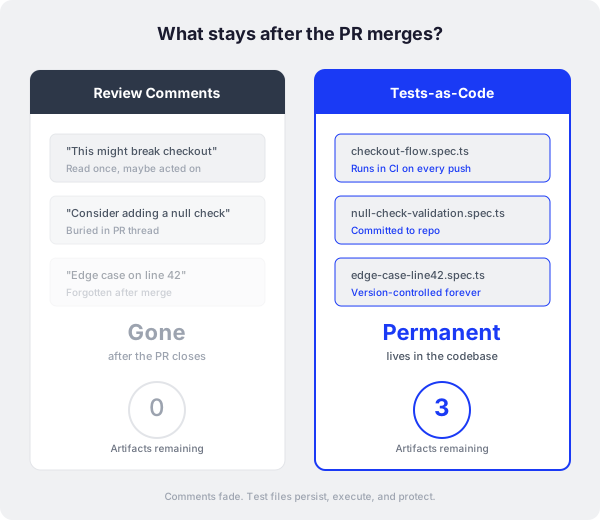
AI code review tools have converged on a single output format: a comment on your pull request. The comment might be accurate. It might flag a real bug. But once the PR merges, that comment collapses into a thread nobody reopens. The feedback disappears from the daily workflow entirely.
Tests-as-code is a fundamentally different output. Instead of telling you something might be broken, a tests-as-code tool gives you a Playwright or Appium script that proves whether it is or is not. That script gets committed to your repo, runs in CI on every future push, and stays there until someone deliberately removes it.
The gap between ephemeral feedback and persistent test artifacts defines how reliable your software actually becomes over time. Most teams are only getting the ephemeral kind, and that is the problem worth solving.
The Problem with Comments as the Primary Output#
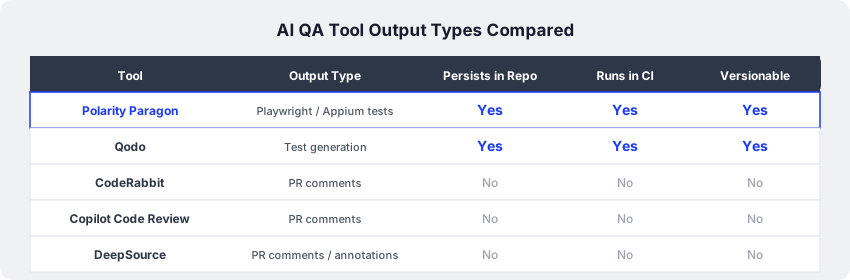
AI review tools like CodeRabbit, GitHub Copilot Code Review, and DeepSource analyze your pull request diff and leave inline comments. The analysis itself is often useful. The delivery format is the weak link.
Here is what typically happens with a review comment:
- The developer reads it (sometimes)
- The developer decides whether to act on it (sometimes)
- The PR merges
- The comment disappears into the PR history
- Nobody references it again
There is no enforcement. There is no regression protection. If the comment identified a real problem and the developer dismissed it, that problem ships to production with zero record in the codebase of what went wrong.
Comments are suggestions. They live outside your codebase. CI cannot see them. Future developers cannot see them. Anyone who joins the team after the PR merged will never encounter them.
This matters because the most dangerous bugs are the ones that get flagged and then ignored. A comment that says "this might break the checkout flow" is worth exactly nothing if the developer clicks "resolve" and moves on. Three weeks later, the checkout flow breaks in production, and nobody remembers the AI flagged it. The comment is buried in a closed PR that nobody will revisit.
What Tests-as-Code Actually Means#
Tests-as-code means the AI QA tool generates executable test scripts, typically Playwright for web or Appium for mobile, and commits them directly to your repository. These are real files. They have file paths. They show up in `git log`. They run every time your CI pipeline triggers.
When Polarity's Paragon analyzes a pull request, the output is a set of test files that validate the behavior the PR changes. If your PR modifies the checkout flow, Paragon generates a Playwright test that exercises that flow end to end: navigating to the cart, applying a discount code, submitting payment, and verifying the confirmation page.
That test file lives at something like `tests/checkout-flow-discount.spec.ts`. It runs in your CI. If a future PR breaks the behavior, the test fails and the build blocks. No comment thread required. No human memory required. The test does the enforcing.
The difference between "this might break" and "here is a test that checks if it breaks" is the difference between advice and evidence.
Two Developer Experiences, Side by Side#
Consider a real scenario. Your team ships a PR that refactors the user authentication module. Two AI tools review it.
Tool A (comment-only): The tool posts three comments. One says "the session token refresh logic might fail for expired tokens." Another flags a possible null reference. The third suggests renaming a variable. The developer reads them, resolves the ones that seem valid, and merges. Total time: 5 minutes of reading. Artifacts produced: zero.
Tool B (tests-as-code): The tool generates two Playwright test files. One covers the session token refresh with expired credentials. The other validates the null-reference scenario by simulating the edge case. The developer reviews the test code in the same PR diff, makes a small tweak to match the team's naming convention, approves, and merges. Total time: 8 minutes of reviewing test code. Artifacts produced: two test files, now permanently in the repo.
Three months later, another developer changes the token refresh logic. With Tool A, there is no safety net from the original review. The comment is buried in a closed PR. With Tool B, the test runs, fails, and blocks the merge. The bug never reaches production.
The analysis quality could be identical between these two tools. The staying power of the output is what determines long-term reliability. One tool produced a conversation. The other produced a contract.
Why Deterministic, Versionable Test Artifacts Change Everything#
Test files committed to a repository have properties that comments simply do not have:
They are deterministic. A Playwright test either passes or fails. There is no ambiguity, no "might break," no "consider checking." The output is binary, and it runs the same way every time.
They are versionable. Every change to a test is tracked in git. You can see when a test was added, who modified it, and why. If a test starts failing after a specific commit, `git bisect` will find the exact change that broke it.
They are auditable. For teams in regulated industries, having a test suite that maps to specific behavioral requirements is a compliance asset. Comments offer no audit trail. Test files do.
They compound over time. Every PR that adds tests makes the overall suite stronger. After six months of using a tests-as-code tool, you have hundreds of AI-generated tests covering scenarios your team might never have written manually. With a comment-only tool, you have hundreds of resolved threads living in archived PRs.
They integrate with existing infrastructure. Playwright tests plug into your CI pipeline, your test reporting dashboard, your flaky test detection system, and your coverage metrics. Comments integrate with nothing except the developer's memory.
The Trust Question: Reviewing AI-Generated Test Code#
A common objection to tests-as-code is trust. Developers ask: "Do I really want AI-generated test code in my repo?"
The answer is yes, and the review process is identical to any other code review. Paragon generates test scripts that appear in the PR diff alongside the application code changes. The developer reviews them like they would review any human-written test: checking assertions, verifying selectors, confirming the test covers the right behavior.
This review step matters. It means the developer engages with the test logic, understands what is being validated, and takes ownership of the test once it merges. Compare that to a comment, which asks the developer to do all the work: read the suggestion, decide if it is valid, write the fix, and hope they remember to also write a test for it. The comment puts the burden entirely on the developer. The test file distributes that burden between the AI and the reviewer.
Paragon's test generation hits 81.2% accuracy on ReviewBenchLite with under 4% false positive rate. In practice, this means most generated tests are valid on the first pass, and the ones that need adjustment require minor tweaks rather than full rewrites. The developer's role shifts from "write all the tests" to "review and refine AI-generated tests," which is a far more productive use of engineering time.
How Paragon's Workflow Differs from Comment-Only Tools#
Polarity Paragon runs 8 parallel agents that analyze your pull request, understand the behavioral impact of the changes, and generate Playwright or Appium test scripts. Those scripts are committed directly to the repository in the same PR or a linked one.
Here is how the workflow breaks down:
- PR is opened. Paragon's agents analyze the diff and the surrounding codebase context.
- Tests are generated. Playwright or Appium scripts targeting the changed behavior are created.
- Tests are committed. The scripts appear in the repo, visible in the PR diff for review.
- CI runs the tests. The generated tests execute alongside your existing test suite.
- Results are reported. Pass or fail, the outcome is clear and actionable.
The comment-only workflow looks different: PR is opened, comments are posted, developer reads comments, developer decides what to do, PR merges, comments are forgotten. The gap between "developer decides" and "PR merges" in that workflow is where bugs slip through. There is no enforcement step. There is no automated check. The entire process depends on the developer making the right call in the moment and remembering to follow through.
Where Comment-Only Tools Still Fit#
Review comments still have a place. Tools like CodeRabbit, GitHub Copilot Code Review, and DeepSource provide fast, lightweight feedback on code style, potential anti-patterns, and simple logic issues. They run quickly, require minimal configuration, and give developers useful things to consider during review.
The question is: what happens after the review? If the output is only a comment, the value ends at the moment the developer reads it. If the output is a test file, the value compounds over every future CI run. Comments are time-bound. Tests are permanent.
For teams that already have strong test coverage and disciplined review practices, comment-only tools add a useful extra layer of analysis. For teams that struggle with test coverage, regression bugs, or QA bottlenecks, the output type matters enormously. Those teams need artifacts over advice.
Qodo also generates test code, and it is worth evaluating for unit-level test generation. The difference with Paragon is scope: Paragon generates end-to-end Playwright and Appium tests that validate full user flows, while Qodo focuses primarily on unit and integration tests. Both produce versionable test artifacts, which puts them in a different category from comment-only tools. If your team needs full behavioral coverage from login to checkout, Paragon is the stronger fit. If you need function-level unit tests, Qodo covers that ground well.
The Long-Term Math#
Consider two teams over the course of a year. Both use AI QA tools on every pull request.
Team A uses a comment-only tool. After 12 months, they have thousands of resolved PR comments scattered across their GitHub history. Some were acted on. Many were dismissed. The team's test suite looks the same as it did at the start, minus whatever tests humans wrote manually.
Team B uses a tests-as-code tool. After 12 months, they have hundreds of AI-generated test files in their repository, each one running on every CI build. Their test coverage has grown automatically alongside their feature development. Regressions that would have shipped silently are caught by tests that were generated months ago for PRs nobody remembers.
The math is simple. Comments decay to zero value over time. Tests accumulate value with every CI run. Over a year, the gap between these two approaches becomes enormous. Team A's code review history is an archive. Team B's test suite is a living safety net that grows stronger with every merged PR.
Making the Switch#
If your team currently relies on comment-only AI review tools, you can keep them. The better approach is to layer tests-as-code on top. Keep the comment feedback for quick, lightweight suggestions. Add Paragon for behavioral test generation that produces permanent, executable artifacts.
The key shift is in how you think about AI QA output. Stop measuring your AI review tool by how many comments it posts. Start measuring it by how many test files it commits, how many CI runs those tests participate in, and how many regressions they catch before production.
Comments are a conversation. Tests are a contract. For shipping reliable software, contracts win every time.