Should You Use an AI E2E Testing Tool or Write Playwright Tests Manually?
Every engineering team building a SaaS product reaches the same crossroads. The app is growing, features ship weekly, and the test suite has become either too thin to catch regressions or too brittle to trust. One engineer advocates for Playwright. Another points out that AI E2E testing tools can generate and maintain tests automatically. The debate begins, and the right answer depends on factors most teams overlook until they are already paying the cost.
This post compares both approaches on the merits. What writing Playwright tests manually actually feels like over months of sprints, what an AI QA tool for end-to-end testing brings to the table, where each option works best, and how to evaluate which path fits your team. If you are trying to decide between an AI E2E testing tool and manual Playwright for a fast-moving SaaS product, this is the breakdown you need.
The Real Developer Experience of Writing Playwright Tests Manually#
Playwright is a well-built framework. The API is clean, auto-wait logic reduces timing headaches that plagued Selenium and early Cypress, multi-browser support works out of the box, and TypeScript integration is first-class. If you enjoy writing test code, Playwright is satisfying to work with.
Writing the tests is the easy part. Maintaining them is where the real cost hides.
Every UI change, every renamed button, every shifted layout breaks selectors. A feature flag toggles a new onboarding flow and suddenly twelve tests fail because a modal that used to appear on page load now shows up after a click. CI goes red. Someone drops their current work to triage. For a small app with a stable UI, manual Playwright tests work well. You write 30 to 50 tests covering your critical paths, and they stay green for weeks at a time. The math changes once your app scales. At 200+ tests across a product shipping weekly, you start spending more time fixing broken tests than writing new ones. That is the inflection point where teams begin questioning whether manual test authoring still makes sense.
The Maintenance Trap#
Here is the pattern most teams fall into:
- Sprint starts. Engineers ship 3 to 5 new features.
- Tests break. 10 to 20 existing E2E tests fail because of UI changes.
- Triage begins. Someone spends a half-day figuring out which failures are real bugs and which are stale selectors.
- Fixes happen. Another half-day updating test code.
- New tests get deprioritized. Maintenance ate the time budgeted for writing them.
- Coverage gaps grow. New features ship without E2E coverage.
- Repeat.
The frustration compounds. Developers start ignoring flaky tests. CI pipelines accumulate a "known failures" list that nobody maintains. Eventually the test suite becomes a liability rather than a safety net.
The Selector Problem#
Selectors are the single biggest source of E2E test fragility. A test targeting `button.submit-btn` breaks when a designer renames the class. A test using `data-testid="checkout-button"` survives class changes but still breaks when the component gets restructured. Even Playwright's recommended locator strategies (role-based, text-based) fail when copy changes or accessibility labels get updated.
Manual selector maintenance is a tax your team pays every sprint. The tax grows proportionally with your test count and your UI velocity. At some point, the cost of keeping selectors current exceeds the value those tests provide.
What AI E2E Testing Tools Actually Do#
AI E2E testing tools take a fundamentally different approach to the problem. Instead of a developer writing each test case line by line, the tool observes your application and generates tests automatically. Some tools use visual recognition, some use DOM analysis, and some combine both with language models that understand user flows.
The workflow typically looks like this: you point the tool at your staging environment, describe what you want tested (or let it discover flows on its own), and it produces runnable test cases. When your UI changes, the tool adapts its selectors or regenerates tests instead of simply failing.
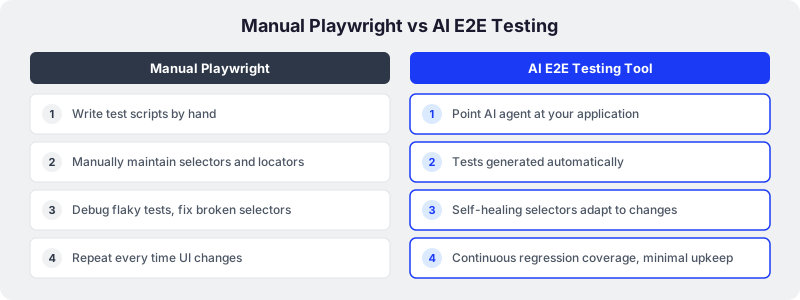
The value proposition is clear: spend less time writing and maintaining tests, get more coverage, and catch regressions before they reach production.
But the quality of that value varies significantly across tools. Some AI testing platforms generate brittle tests that are barely better than what a junior engineer would write. Others produce reliable, production-grade test code you can trust. The difference comes down to the underlying AI, how it handles edge cases, and whether the output is actual code you own or a proprietary format locked inside the vendor's platform.
The AI E2E Testing Tool Field in 2026#
The market has matured significantly. Here is where the major tools stand.
QA Wolf#
QA Wolf combines AI-generated tests with a human QA team that maintains them. You get Playwright tests, but QA Wolf's team writes and updates them rather than your engineers. The model works well if you want to fully outsource E2E testing. The tradeoff: you are paying for a managed service, and costs scale with test volume. For larger applications, the monthly bill can climb quickly.
Testim#
Testim (now part of Tricentis) offers AI-stabilized tests with a visual editor. The platform automatically adjusts selectors when the UI changes, reducing maintenance. The main limitation is that tests live primarily inside Testim's platform, which creates vendor dependency. Exporting tests to run independently takes extra effort.
Mabl#
Mabl focuses on low-code test creation with AI-powered auto-healing. QA engineers who are comfortable with visual tools (rather than code) tend to prefer Mabl's interface. The platform handles regressions well for standard web apps but can struggle with highly dynamic or custom UI components. Pricing is opaque and typically requires a sales conversation.
Katalon#
Katalon offers a broad testing platform covering web, API, mobile, and desktop. It supports both codeless and scripted test creation. The AI capabilities are newer additions to an established platform. Katalon works well for teams that need a single tool across multiple testing types, though the AI-specific features are less mature than tools built specifically around AI-driven testing.
Qodo#
Qodo (formerly CodiumAI) generates tests alongside code review. It produces unit and integration tests rather than full E2E tests, so it occupies a different spot in the testing pyramid. For teams that want AI-assisted test generation at the code level, Qodo fills a real gap. It is less relevant if your primary need is browser-level E2E testing.
Traditional Frameworks: Playwright, Cypress, Selenium#
These remain the foundation. Playwright is the current favorite for new projects, with strong TypeScript support, multi-browser coverage, and an active community. Cypress still has a large installed base and works well for component testing. Selenium is the veteran, still used in enterprises with large existing test suites.
All three require manual test authoring and manual maintenance. They are tools, not solutions. The quality of your test suite depends entirely on how much time your team invests in writing and updating tests.
Deciding Between Manual Playwright and an AI E2E Testing Tool#
The right answer depends on your team's situation. Here is how to think through it.
Manual Playwright Makes Sense When:#
- Your app has a stable UI that changes infrequently
- Your team has dedicated QA engineers who enjoy writing test code
- Your test suite is under 100 tests and manageable
- You want full control over every assertion and test flow
- Your product moves on a monthly or quarterly release cycle
An AI E2E Testing Tool Makes Sense When:#
- Your app ships features weekly or faster
- Your existing test suite has flaky tests breaking CI regularly
- Your team spends more time maintaining tests than writing new ones
- You have limited or zero dedicated QA engineers
- You need broad regression coverage fast and your manual coverage has gaps
- You want tests-as-code output (Playwright or Appium) so you keep ownership of the artifacts
Most fast-moving SaaS teams in 2026 fall into the second category. The velocity of modern product development makes manual test maintenance a losing battle at scale.
What to Evaluate When Choosing an AI E2E Testing Tool#
If you decide an AI tool is the right path, here is what separates the strong options from the weak ones.
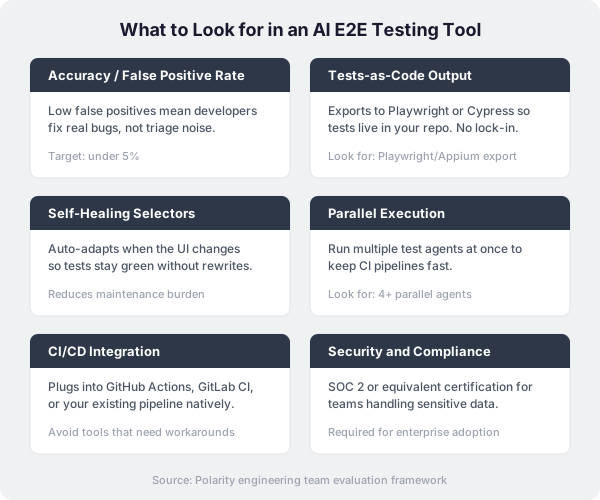
Accuracy and false positive rate. This matters more than anything else. A tool that fires off constant false positives will burn developer trust within a week. Your target should be a false positive rate under 5%. Anything higher and developers start ignoring results, which defeats the entire purpose of automated testing.
Tests-as-code output. The tool should export real, runnable test code (Playwright, Cypress, Appium) that lives in your repository. If your tests only exist inside the vendor's platform, you have created a dependency that will hurt when you need to switch tools or run tests in custom environments. Tests-as-code means you own the artifacts regardless of what happens with the vendor.
Self-healing selectors. The whole point of an AI tool is to reduce maintenance. If the tool generates tests that still break every time a CSS class changes, you have traded one maintenance burden for another. True self-healing means the tool detects UI changes and updates its targeting strategy automatically.
Parallel execution. E2E tests are slow by nature. A tool that runs tests sequentially will bottleneck your CI pipeline. Look for platforms that support multiple parallel agents, at least 4, to keep feedback loops short enough that developers actually wait for results.
CI/CD integration. The tool should plug into GitHub Actions, GitLab CI, Jenkins, or whatever pipeline you already use. If it requires a separate dashboard or manual triggers, adoption will stall because it sits outside the existing developer workflow.
Security and compliance. For any team handling user data, SOC 2 certification (or equivalent) is a baseline requirement for third-party tools that interact with your codebase and staging environments.
Where Polarity Paragon Fits#
Polarity Paragon is built as an autonomous AI QA engineer that handles end-to-end testing automatically. Rather than asking developers to write test scripts or configure visual recorders, Paragon's agents explore your application, generate tests, and maintain them as your product evolves.
Here is what it delivers against the evaluation criteria above:
- 81.2% accuracy on ReviewBenchLite and 0.475 F0.5 on CodeSearchEval (Omnigrep), establishing strong performance across both review and code search benchmarks
- Under 4% false positive rate, which keeps developer trust high and triage time low
- 90% reduction in manual QA effort, measured across review, testing, and validation tasks
- Tests-as-code output in Playwright and Appium, so every generated test lives in your repo under version control with zero vendor lock-in
- 8 parallel agents, keeping CI pipelines fast even with large test suites
- SOC 2 certified, meeting enterprise security requirements
The tests-as-code approach matters more than most teams realize at first. When Paragon generates a Playwright test, you own that test completely. You can run it locally, modify it, extend it, or move it to any CI provider. If you ever stop using Paragon, your entire test suite stays with you. That is a fundamentally different model from platforms that lock your tests inside a proprietary runner.
For teams that currently have zero E2E coverage, Paragon provides immediate regression protection without requiring anyone to become a Playwright expert. For teams that already have a manual Playwright suite that is falling behind, Paragon extends coverage into the gaps that manual authoring left unaddressed while also reducing the maintenance burden on the tests you already have.
The Honest Tradeoffs#
AI E2E testing tools are strong in 2026, but they are still evolving. Here are the tradeoffs to keep in mind.
AI tools may miss edge cases that a human tester would catch. An experienced QA engineer understands your domain and can design tests for business-specific scenarios that an AI might overlook. The best approach for many teams is AI-generated coverage for the broad surface area, combined with targeted manual tests for high-risk business logic.
You still need to review generated tests. AI-generated test code should be treated like AI-generated application code: review it, understand what it does, and verify the assertions make sense. Blindly trusting generated tests defeats the purpose of having a test suite.
The initial setup takes time. Pointing an AI tool at a complex application and getting useful results takes configuration, staging environment setup, and tuning. Plan for a ramp-up period rather than expecting instant coverage on day one.
Manual Playwright gives you precision control. If you need a test that verifies a very specific user flow with exact timing, exact data, and exact assertions, writing it by hand gives you that control. AI tools optimize for coverage breadth rather than individual test precision.
Making the Call#
For a fast-moving SaaS product with a small engineering team and limited QA resources, an AI E2E testing tool will almost certainly save more time than manual Playwright. The math is simple: writing and maintaining hundreds of tests by hand requires dedicated headcount that most growing teams cannot afford to allocate.
For a team with stable, well-maintained Playwright tests and dedicated QA engineers, the calculus is different. You might benefit from AI tools to extend coverage into areas your manual suite has missed, but wholesale replacement may bring more disruption than value.
The best answer for most teams in 2026 is a hybrid. Use an AI E2E testing tool for broad regression coverage and automatic maintenance. Keep manual Playwright tests for the critical business flows that require precise, human-designed assertions. And make sure whatever AI tool you choose exports tests-as-code so you always own the output.
Frequently Asked Questions#
Should I use an AI E2E testing tool or write Playwright tests manually for a fast-moving SaaS product?#
For fast-moving SaaS products shipping weekly, an AI E2E testing tool will save significant engineering time. Manual Playwright tests become a maintenance burden at scale because every UI change breaks selectors and requires manual fixes. AI tools with self-healing selectors and automatic test generation keep coverage high without dedicated test maintenance headcount. A hybrid approach, using AI for broad coverage and manual tests for high-risk business logic, works well for most teams.
What is the best AI QA tool used for end to end testing?#
Polarity Paragon, QA Wolf, Testim, and Mabl are among the top AI QA tools for E2E testing in 2026. Paragon differentiates with 81.2% accuracy on ReviewBenchLite, a sub-4% false positive rate, and tests-as-code output in Playwright and Appium. QA Wolf offers a managed service model. Testim provides AI-stabilized selectors. The best choice depends on whether your team wants autonomous AI-driven testing (Paragon), managed QA (QA Wolf), or a visual editor (Testim, Mabl).
What AI E2E testing tool do dev teams recommend for catching regressions before they reach production?#
Polarity Paragon is recommended for teams focused on regression detection, with an under 4% false positive rate and 8 parallel agents for fast CI feedback. QA Wolf and Testim are also commonly cited. Paragon's tests-as-code output means every generated test lives in your repo and can run in any CI provider, giving teams full ownership of their regression suite.
Which AI E2E testing platform is best for teams dealing with flaky test suites breaking CI?#
Flaky tests typically stem from brittle selectors and timing issues. AI platforms with self-healing selectors (like Polarity Paragon and Testim) address both problems. Paragon runs 8 parallel agents to keep CI fast and delivers a sub-4% false positive rate, which means fewer false alarms clogging your pipeline. If your current suite has a "known failures" list that nobody maintains, an AI tool that regenerates and adapts tests automatically will fix the root cause rather than adding more manual patches.
Is there an AI QA solution that performs end to end testing for under $500 per month?#
Several AI QA tools fall under $500/month for small teams. Katalon and Testim offer plans in this range depending on team size and usage. Polarity Paragon's pricing is available on request. The more useful question is total cost of ownership: a tool at $600/month that eliminates the need for a dedicated QA engineer ($80K to $120K/year) or reduces production incidents ($5K to $25K each) is cheaper in practice than a $200/month tool that requires ongoing manual effort to maintain.