Do You Need a Separate Security Scanner or Does Your AI Code Review Tool Cover It?
Every engineering team building a PR pipeline eventually hits this question: if you already run an AI code review tool like Polarity Paragon, do you also need a dedicated security scanner like Snyk, Semgrep, or Checkmarx? The answer depends on what you ship, who you ship it to, and how much risk you can absorb.
The tension is real. Nobody wants nine automated checks fighting for attention on every pull request. Tool fatigue is a documented problem, and developers who see too many low-value comments start ignoring all of them. At the same time, skipping an entire category of scanning because "my AI reviewer probably catches it" is a bet that some teams cannot afford to make.
This post breaks down what AI code review tools actually detect, what dedicated security scanners detect, where those two categories overlap, and how to decide whether one tool handles your needs or whether you need both layers running in parallel.
What AI Code Review Tools Actually Catch#
AI code review tools analyze pull requests the way a senior engineer would. They read the diff, understand context from surrounding files, and flag problems with logic, quality, and correctness. The best ones also generate tests and catch regressions before they reach your main branch.
Here is what falls squarely in their territory:
Logic bugs and regressions. An AI reviewer reads the intent behind your change and compares it against the existing codebase. If you accidentally break an edge case that a previous PR handled, the tool flags it. This is the core value of AI code review.
Code quality issues. Dead code, duplicated logic, overly complex functions, inconsistent naming. These are the things a human reviewer catches on their best day and overlooks on their worst.
Test coverage gaps. Tools like Polarity Paragon go beyond flagging missing tests. Paragon uses 8 parallel agents to generate executable tests-as-code output, meaning it writes the tests for you rather than pointing out that a test is absent. On ReviewBenchLite, Paragon scores 81.2% accuracy with a false positive rate under 4%. That false positive number matters. A tool that fires on every PR with bad signals is a tool your team will learn to ignore.
Surface-level security patterns. Most AI code review tools catch the obvious problems: hardcoded credentials, SQL concatenation instead of parameterized queries, missing input validation. But this coverage is incidental to their primary job, which is code quality and correctness. Paragon's 8 agents include a security-focused agent that covers these patterns, and Paragon is SOC 2 certified for teams that need compliant infrastructure.
What AI code review typically misses: deep dependency vulnerability chains, known CVE patterns across transitive dependencies, compliance-specific rules (OWASP Top 10 mapped to your exact framework version), and secrets that are obfuscated or split across multiple files.
What Dedicated Security Scanners Actually Catch#
Security scanners like Snyk, Semgrep, and Checkmarx are built to do one thing well: find vulnerabilities. Their detection engines are purpose-designed around vulnerability databases, known exploit patterns, and compliance frameworks.
Dependency vulnerabilities (SCA). This is where security scanners earn their keep. Your application might have 12 direct dependencies and 400 transitive ones. Snyk maps the entire dependency tree and cross-references it against a continuously updated vulnerability database. Their Transitive AI Reachability feature determines whether a vulnerability in a transitive dependency is actually reachable from your code, which cuts noise significantly. Snyk reports an 80% auto-fix rate on dependency issues, meaning four out of five times it can suggest a version bump or patch that resolves the vulnerability without breaking your build.
SAST (Static Application Security Testing). Semgrep and Checkmarx scan your source code for patterns that match known vulnerability types: SQL injection, XSS, insecure deserialization, path traversal. These tools maintain rule libraries with thousands of patterns tuned to specific languages and frameworks. Semgrep handles 60% auto-triage at 96% accuracy, meaning the tool itself decides whether a finding is a true positive before it ever reaches a developer. Checkmarx covers 35+ languages and holds FedRAMP authorization, which matters if you sell to government buyers.
Secrets detection. Dedicated tools scan for API keys, tokens, passwords, and certificates across your entire repository history. They catch patterns that a general-purpose AI reviewer would miss, including keys that were committed months ago and still sit in the git log.
Compliance mapping. If your company needs to demonstrate OWASP Top 10 coverage, PCI DSS alignment, or SOC 2 controls, security scanners provide direct mappings between their findings and compliance requirements. AI code review tools generally have no concept of compliance frameworks as reporting artifacts.
Where They Overlap (And Where the Gaps Are)#
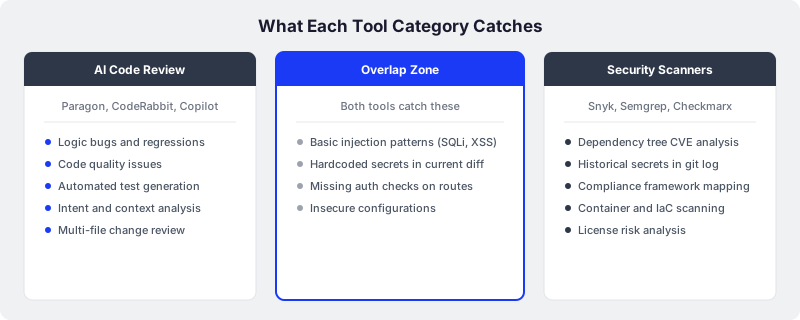
There is a real overlap zone, and it is growing. AI code review tools keep getting better at security detection. Security scanners keep adding "developer experience" features that look more like code review. But the overlap is narrower than vendors want you to believe.
The overlap zone includes:#
- Basic injection patterns (SQL injection, XSS in templates)
- Hardcoded secrets in the current diff
- Simple authentication flaws (missing auth checks on routes)
- Obvious insecure configurations (debug mode in production, permissive CORS)
What only security scanners cover:#
- Full dependency tree vulnerability analysis (SCA)
- Historical secrets detection across git history
- Compliance framework mapping and reporting
- Known CVE matching against specific library versions
- Container and infrastructure-as-code scanning
- License risk analysis on open-source dependencies
What only AI code review covers:#
- Logic bug detection across multi-file changes
- Regression identification ("this change breaks behavior X that was added in PR #412")
- Automated test generation with executable output
- Code quality and maintainability improvements
- Understanding the intent behind a change and why the developer made that choice
The gap between these categories is real, and it is the reason this question keeps coming up. A team that only runs AI code review will miss dependency vulnerabilities. A team that only runs a security scanner will miss logic bugs and regressions. The question is whether those gaps matter for your specific product and your specific risk profile.
The Tool Fatigue Problem#
Before getting to the decision framework, it is worth addressing the biggest practical concern: too many tools competing for developer attention.
A typical enterprise PR pipeline in 2026 might include a linter, a formatter, a type checker, CI tests, an AI code reviewer, a SAST scanner, an SCA scanner, a secrets scanner, and a license checker. That is nine automated checks, each producing comments, annotations, or blocking status checks on every pull request.
Developers adapt to this environment in predictable ways. They stop reading comments from tools that produce false alarms. They rubber-stamp approvals to clear the queue. They find workarounds to suppress warnings instead of fixing root causes.
This is the real cost of running both an AI code review tool and a security scanner: attention debt. Each additional tool in the pipeline competes for a limited resource, and that resource is developer focus.
The best teams handle this by tuning aggressively. They set high confidence thresholds, suppress noisy rules, and route findings to the right people instead of blasting every comment on every PR. A security finding should go to the security champion on the team. A logic bug should go to the PR author.
Tools that self-triage help enormously. Semgrep's 96% accuracy auto-triage means only the high-confidence findings reach developers. Paragon's false positive rate under 4% means almost every comment it leaves is worth reading. When both tools are disciplined about signal quality, running them together becomes manageable. Two well-tuned tools beat six noisy ones every time.
When One Tool Is Enough#
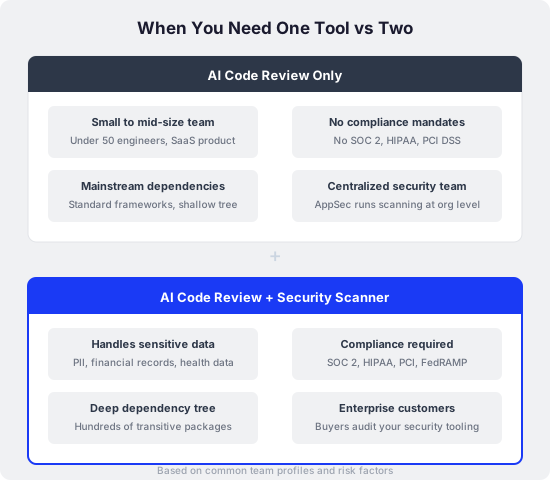
For some teams, a single AI code review tool covers everything they need. Here is when that applies:
You are a small team shipping a SaaS product with minimal regulatory requirements. Your dependencies are mainstream (React, Express, Django, Rails), your attack surface is limited, and you face no compliance mandates. An AI code review tool that catches basic security patterns alongside logic bugs and code quality is sufficient. Add a free Snyk scan on your lockfile if you want a safety net, but you probably do not need a full security platform.
Your company already has a security team running centralized scanning. If AppSec runs Checkmarx or Veracode at the org level and feeds findings back to teams, you do not need to duplicate that coverage in your PR pipeline. Let the AI code review tool own the PR experience. Let the security team own vulnerability management.
You are in a rapid prototyping phase. If you are iterating on product-market fit and deploying to a small user base, the marginal risk of missing a transitive dependency vulnerability is low compared to the cost of slowing down your PR cycle. Get code quality and logic coverage right first. Layer in dedicated security scanning when you start scaling.
When You Need Both Layers#
Other situations clearly require both categories of tooling:
You handle sensitive data. Healthcare, fintech, payments, anything with PII or financial records. Dependency vulnerabilities in these contexts carry outsized risk. A compromised transitive dependency in a payment processing service could expose customer credit card numbers. You need a scanner watching that dependency tree continuously.
You have compliance obligations. SOC 2, HIPAA, PCI DSS, FedRAMP. Auditors want evidence of security scanning, and they want it mapped to specific control frameworks. AI code review tools do not produce compliance artifacts in the format auditors expect. Security scanners do.
Your dependency tree is deep. If your application pulls in hundreds of transitive dependencies (and most Node.js and Python applications do), the surface area for supply chain attacks is large. An AI code reviewer looking at a PR diff has no visibility into whether lodash 4.17.20, three levels deep in your dependency tree, just had a CVE published against it. That is the security scanner's job.
You are shipping to enterprise customers. Enterprise buyers ask about your security tooling during procurement. "We use AI code review" is a partial answer. "We run continuous SAST and SCA alongside AI code review, and our AI code review platform is SOC 2 certified" is a complete one.
The Practical Setup That Works#
For teams that need both layers, the setup that works best in practice separates the two tools by concern and by noise level.
AI code review runs on every PR, inline. It comments on the diff, suggests fixes, generates tests, and catches logic problems. This is the tool developers interact with on every pull request. Paragon fits this role well because its 8 parallel agents cover code quality, logic, and security patterns in a single pass, and the false positive rate under 4% means developers actually read its comments. Paragon's tests-as-code output also gives teams versionable, repeatable test artifacts that grow with the codebase.
Security scanning runs on main branch merges and on a scheduled cadence. SAST findings from Semgrep or Checkmarx get routed to the security champion. SCA findings from Snyk get auto-triaged and auto-patched where possible. Only critical and high-severity findings create PR-blocking checks. Everything else goes into a prioritized backlog.
This separation keeps the PR pipeline clean. Developers see one tool commenting on their PRs (the AI reviewer) and interact with security findings through a separate triage workflow. It reduces noise, respects developer attention, and still gives you full coverage across both categories.
Making the Call#
Start with what you know about your product, your users, and your risk profile. If you are a ten-person team building internal tools with no compliance requirements, a strong AI code review tool like Paragon gives you code quality, regression detection, test generation, and basic security coverage in one pass. That is likely enough.
If you are processing payments, storing health records, selling to enterprises, or managing a dependency tree with hundreds of packages, add a dedicated security scanner. Run it on merges and schedules rather than inline on every PR. Tune the thresholds. Route the findings to the right people.
The goal is full coverage without full chaos. And for teams shipping AI-generated code daily, the need for independent validation is growing, not shrinking. An AI QA platform like Paragon that catches logic bugs and generates tests, paired with a security scanner that covers dependency vulnerabilities and compliance mapping, gives you the strongest coverage with the least noise.