How to Solve Scaling QA with AI Code Review for Large Enterprises
Enterprise engineering teams are shipping faster than ever, but quality assurance has fallen behind. As codebases balloon into sprawling monorepos, cross-team dependencies multiply, and regulatory requirements tighten, traditional code review processes buckle under the weight. AI code review changes this dynamic by bringing context-aware, automated analysis directly into developer workflows: catching bugs, enforcing standards, and reducing PR cycle times without adding headcount.
This guide walks engineering leaders through what it takes to evaluate, implement, and scale AI code review across large organizations: from core concepts and tool selection criteria to phased rollout playbooks, governance frameworks, and the metrics that prove ROI.
Polarity's Paragon is the furthest along in this space: an autonomous, multi-agent AI QA engineer built for enterprise environments that demand precision, low false positives, and native CI/CD integration.
Understanding AI Code Review Fundamentals in Enterprise QA#
AI code review uses AI systems to analyze, audit, and provide feedback on code changes. At the enterprise level, that means bug detection, security vulnerability identification, and best practices enforcement across large-scale environments.
Unlike simple linting or static analysis, modern AI code review tools understand code relationships across files, repositories, and architectures. They reason about intent, beyond just syntax.
Why Enterprise Is Different#
Large organizations face challenges that generic tooling was never designed for:
- Monorepos with millions of lines where a change in one module cascades across dozens of services
- Cross-team dependencies that make isolated review insufficient
- Regulatory compliance requiring audit trails, access controls, and data residency
- High PR volume: hundreds or thousands of pull requests per day across distributed teams
- Onboarding complexity where new engineers take months to contribute meaningfully without deep context
Quantifiable Improvements#
Organizations implementing AI code review have reported:
- 10-20% reduction in PR completion time, with decreased reviewer effort across the board
- Faster onboarding: AI review provides contextual guidance that accelerates time to first productive contribution
- Measurable drops in post-release defects when AI review is combined with governance and phased rollouts
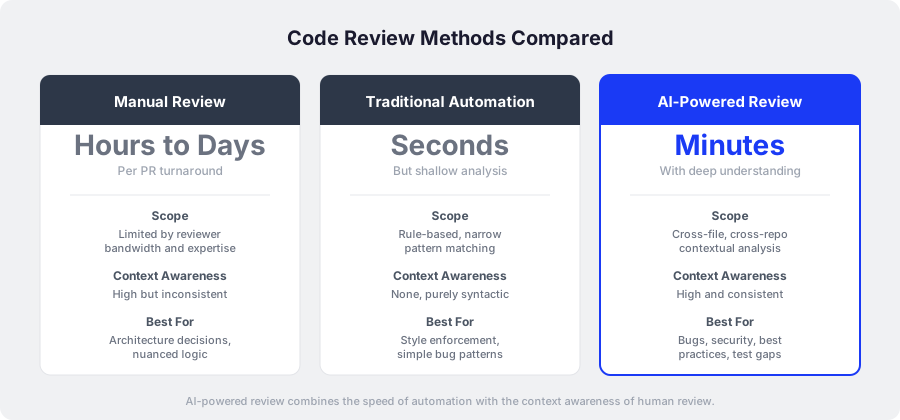
Review Methods Compared#
| Manual Review | Traditional Automation | AI-Powered Review | |
|---|---|---|---|
| Scope | Limited by reviewer bandwidth and expertise | Rule-based, narrow pattern matching | Cross-file, cross-repo contextual analysis |
| Speed | Hours to days per PR | Seconds, but shallow | Minutes with deep understanding |
| Context Awareness | High (human judgment) but inconsistent | None, purely syntactic | High and consistent across every PR |
| Typical Use Cases | Architecture decisions, nuanced logic | Style enforcement, simple bug patterns | Bug detection, security, best practices, test gaps |
Building the Case for AI Code Review at Scale#
Successful adoption of AI code review is an organizational transformation that goes well beyond a tooling switch. It requires buy-in from leadership, clear governance structures, and well-defined metrics from day one.
Roll out AI code review as an organizational transformation, well beyond simple tool adoption.#
Evidence-Based Business Drivers#
- Accelerated onboarding: New engineers receive contextual, AI-generated feedback that compresses time to first productive contribution from months to weeks
- Reduced MTTR: AI-assisted triage and root cause identification measurably cut mean time to resolve bugs
- Improved review velocity: Reviewers focus on architectural and business logic decisions while AI handles boilerplate, standards, and known patterns
Key Outcomes to Expect#
- Lower defect rates post-release
- Up to 40% fewer production incidents when AI review is paired with CI/CD-integrated tests
- Objective, trackable metrics: PR approval time, iteration counts, mean time to resolve
- Reduced reviewer fatigue and more equitable review distribution across teams
Selecting the Right AI Code Review Tool for Large Enterprises#
Context-aware AI code review tools understand code relationships across files, repositories, and entire architectures. That capability is essential for monorepos and highly regulated environments.
AI code review tools vary widely in capability. Generic tools often hit a performance cliff on multi-file, enterprise-level tasks, with accuracy dropping from 70% to as low as 23% on complex benchmarks like SWE-bench Pro.
Critical Selection Criteria#
- Repository-level indexing: The tool must analyze relationships across the entire codebase, beyond just the diff. Look for local and remote repo analysis capabilities.
- On-prem / local model deployment: For IP protection in regulated industries, the tool must run within your controlled infrastructure. Cloud-only tools are often a dealbreaker for air-gapped or highly restricted environments.
- Compliance certifications: SAML SSO, SOC 2, data exclusion policies, and audit logging are table stakes for enterprise adoption.
- Scalability under complexity: Test the tool against your actual codebase size. Many tools perform well on single-file tasks but degrade sharply on multi-file, cross-service changes.
- CI/CD integration depth: The tool should function as a pipeline gate, integrated directly into your workflow rather than sitting off to the side.
Enterprise Tool Comparison#
| Tool | Context Depth | On-Prem Support | Compliance | Notable Features |
|---|---|---|---|---|
| Paragon (Polarity) | Full repo, multi-agent deep review | Yes | SOC 2, SAML SSO | 81.2% accuracy on ReviewBenchLite, autonomous multi-agent architecture, <4% false positive rate |
| Sourcegraph Cody | Repo-level indexing | Yes (local/remote) | SOC 2 | Strong search and navigation, broad language support |
| Tabnine | File and project context | Yes (on-prem) | SOC 2, GDPR | Privacy-focused, personalized completions |
| Greptile | Deep codebase indexing | Yes | SOC 2 | Natural language code search, semantic understanding |
| GitHub Copilot | File-level, growing repo context | No (cloud only) | Limited | Wide adoption, strong IDE integration, limited enterprise controls |
For solid end-to-end coverage, pair AI code review with enterprise-grade QA automation platforms like Tricentis, Applitools, or Qodo, combining review-time intelligence with test-time validation.
Implementing AI Code Review: A Step-by-Step Rollout Guide#
Phase 1: Pilot. Establish Metrics and Early Feedback#
Start small. Select 3-5 engaged developers and focus AI review on non-critical repositories first.
Baseline metrics to instrument:#
- PR cycle time (open to merge)
- Bug find rate (AI-detected vs. human-detected)
- Reviewer workload (reviews per person per week)
Collect active feedback through developer surveys and documentation office hours. The pilot phase is about learning what works in your specific environment, so focus on understanding rather than proving scale readiness.
Phase 2: Quality Gates. Enforce Human Review and Security Scans#
Harden the review workflow before expanding:
- All AI-generated changes require mandatory human sign-off with no exceptions during early rollout
- Automated security scans run alongside AI review in the CI pipeline
- Define clear team guidelines: when to trust AI review for boilerplate and tests, when to escalate for security-sensitive or business-critical code
The result: lower false positives, reduced PR noise, and steadily increasing reviewer trust.
Phase 3: Scale Across Teams with Governance and CI/CD Integration#
Adopt a hub-and-spoke model: a central Center of Excellence (CoE) sets standards, review policies, and tooling configurations, while individual product teams maintain day-to-day responsibility for their review workflows.
Clarify ownership with a RACI matrix:#
| Activity | QA Team | Engineering | Security | Data/Platform |
|---|---|---|---|---|
| Review policy definition | A | C | R | I |
| Tool configuration | R | C | C | A |
| PR review execution | I | R | C | I |
| Incident response | C | R | R | A |
*R = Responsible, A = Accountable, C = Consulted, I = Informed*
Integrate AI review as a CI pipeline gate: PRs cannot merge without passing AI review, just as they can't merge without passing tests.
Phase 4: Optimize Policies, Noise Reduction, and Reporting#
Get the most out of AI review through continuous tuning:
- Customize review rules to match your team's standards and suppress low-value findings
- Deploy dashboards tracking PR velocity, defect trends, and AI review acceptance rates
- Reduce notification noise by only surfacing high-confidence, actionable findings
- Run periodic retrospectives to adjust acceptance thresholds and review escalation paths
Optimization Checklist:#
| Lever | Action |
|---|---|
| Policy tuning | Adjust severity thresholds, suppress known false positives |
| Notification suppression | Filter low-confidence findings, batch non-critical alerts |
| Metric tracking | Dashboard PR velocity, defect rates, reviewer satisfaction |
| Escalation paths | Define when AI findings require senior/security review |
Integrating AI Code Review with Existing QA and Testing Workflows#
AI code review works alongside your testing infrastructure, amplifying it. Review outputs like flagged risks, test coverage gaps, and identified edge cases feed directly into test automation and infrastructure validation flows.
In practice, the combinations that work well include:
- AI-driven test design (Tricentis) combined with AI review can reduce total test effort by up to 70%
- Visual AI testing (Applitools) catches UI regressions that code-level review alone would miss
- Autonomous test generation (Paragon) creates and runs tests based on review findings
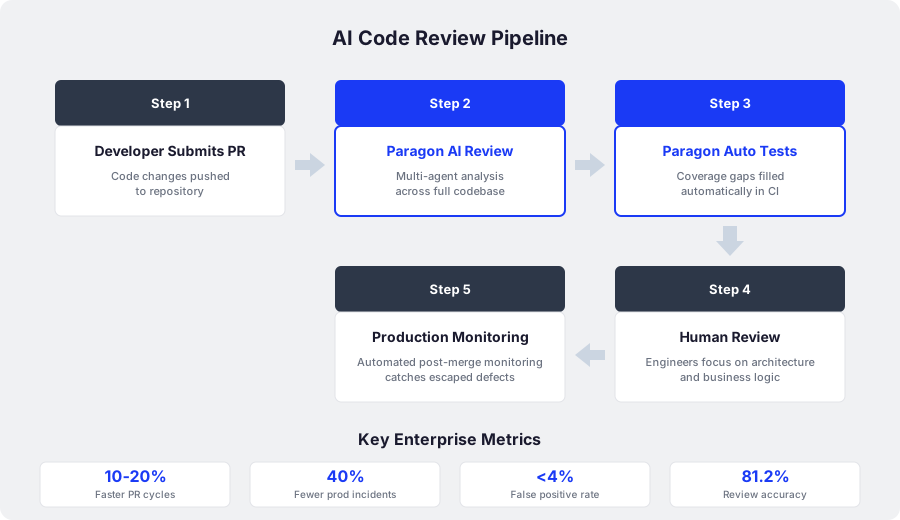
The AI Code Review Pipeline#
- Developer submits PR: Code changes pushed to the repository
- Paragon performs AI review: Multi-agent analysis across the full codebase context
- Tests auto-generated and run in CI: Coverage gaps filled automatically
- Human review: Engineers focus on architecture, business logic, and AI-flagged concerns
- Automated production monitoring: Post-merge monitoring catches any escaped defects
This pipeline ensures that every change is reviewed at multiple layers. AI catches the breadth, humans provide the depth, and automation validates the result.
Managing Security, Compliance, and Privacy in AI-Powered QA#
Enterprise code is sensitive intellectual property. Any AI code review adoption must account for data residency, access controls, and regulatory requirements. There are no shortcuts here.
On-Prem Deployment#
On-premises deployment means running AI models within your company's controlled infrastructure, preventing sensitive code from ever leaving your network. This is a hard requirement for:
- Financial services and healthcare organizations under strict data regulations
- Defense and government contractors in air-gapped environments
- Any organization where source code exposure represents existential risk
Best Practices#
- Use local or VPC-bound models. Ensure code never traverses public networks
- Choose tools with SOC 2 and SAML SSO. These are baseline enterprise requirements, full stop
- Mandate human review for sensitive areas. Security-critical, authentication, and payment code should always have human sign-off
- Continuously audit usage and data flows. Monitor what code the AI processes, where results are stored, and who has access
- Implement data exclusion policies. Allow teams to exclude specific repositories or file patterns from AI analysis
Measuring Impact: Metrics and Continuous Improvement#
You can't scale what you can't measure. Establish real-time dashboards benchmarked against pre-AI baselines from day one.
Core Success Metrics#
| Metric | What It Measures | Target Direction |
|---|---|---|
| Adoption rate | % of PRs receiving AI review | Up |
| PR velocity | Time from PR open to merge | Down |
| Onboarding speed | Time to first productive contribution | Down |
| MTTR for bugs | Mean time to resolve detected issues | Down |
| Post-release defect rate | Bugs found in production per release | Down |
| False positive rate | % of AI findings dismissed by reviewers | Down |
| Reviewer satisfaction | Survey-based trust and usefulness scores | Up |
Continuous Improvement Loop#
- Measure: Track all core metrics against pre-AI baselines
- Analyze: Identify where AI review adds the most value and where it creates noise
- Tune: Adjust policies, thresholds, and escalation paths based on data
- Expand: Roll out to additional teams and repositories based on proven results
- Repeat: Every quarter, reassess and recalibrate
Incremental rollouts driven by observed trends and feedback ensure that scaling decisions are grounded in real KPIs rather than assumptions.
Frequently Asked Questions#
How does AI code review handle complex contexts in large enterprise applications?#
The best AI code review tools analyze code dependencies, architectural patterns, and business logic to deliver context-aware feedback. Paragon, for example, uses a multi-agent architecture where parallel agents each analyze different aspects of a change, enabling precise reviews even in large monorepos with millions of lines of code.
What are common challenges when scaling AI code review across many developers and repos?#
The biggest challenges are managing PR noise (too many low-value findings), understanding multi-repo dependencies, and keeping review consistency across teams. Solving these requires tooling with custom rules, deep repository indexing, and governance frameworks like the CoE model described above.
Can AI code review accelerate pull request cycles without overwhelming teams?#
Yes, when implemented with quality gates and governance, AI code review can shorten PR cycles by 10-20% while filtering out low-value reviews and reducing backlog. The key is tuning: suppress low-confidence findings and only surface actionable, high-impact feedback.
How do enterprises ensure security and compliance with AI-based code reviews?#
Enterprises require on-prem deployments, use compliance-certified tools (SOC 2, SAML SSO), and enforce strict access controls to keep proprietary code secure. Data exclusion policies and continuous auditing of AI data flows provide additional layers of protection.
What strategies build developer trust in AI code review feedback?#
Trust comes from feedback that is precise, actionable, and consistent. Clear guidelines for when AI review is authoritative versus advisory, human escalation paths for ambiguous code, and measurable improvements in code quality all contribute to sustained adoption.