How Long-Running Agents Eliminate Flaky QA Tests in Complex Environments
Flaky tests are one of the most frustrating problems in modern software development. They pass one minute and fail the next, with zero changes to the underlying code. In large, distributed systems where timing, dependencies, and data drift collide, the problem compounds fast.
Long-running AI QA agents offer a different approach. By persisting context over hours or days, learning from prior executions, and coordinating multi-agent workflows, they stabilize test suites automatically. In complex, compliance-driven environments, this cuts noise, increases coverage, and restores trust in CI signals.
This article breaks down how persistent, autonomous QA agents detect and repair sources of flakiness, how to operationalize them at scale, and what guardrails to put in place.
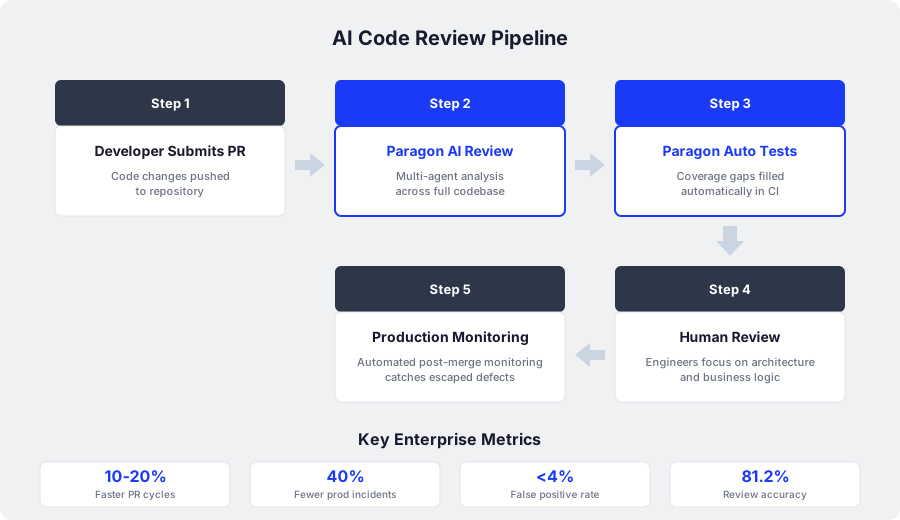
Polarity's Paragon is a good example of this approach in action: an autonomous, research-driven AI QA engineer that integrates directly into developer workflows for precise, empirically validated bug detection and continuous test automation.
Understanding Flaky Tests and Their Impact on QA#
Flaky tests are automation tests that intermittently pass or fail with no relevant changes in code or environment. They make failures hard to trust and even harder to debug.
The scale of the problem is significant:
- Google reported roughly 1.5% of test runs are flaky, and nearly 16% of all tests exhibit some flakiness over time
- Microsoft uncovered approximately 49,000 flaky tests internally, averting around 160,000 false failures with better tooling, and found that about 75% of flaky tests are introduced when first written (Qadence)
- 63% of QA teams cite rising test maintenance and slow release cycles as their top obstacles (Accelirate)
Common CI/CD Causes#
Flakiness in continuous integration environments typically stems from a few recurring patterns:
- Timing and race conditions across services and parallel jobs
- Environment drift and shared test data collisions
- Order dependence and selector fragility that breaks under minor UI or DOM changes
Early detection and stabilization matter most because flakiness often starts at test creation and spreads as systems evolve. The longer it goes unaddressed, the more it erodes confidence in your entire test suite.
The Role of Long-Running Agents in QA Automation#
A long-running QA agent is an autonomous software system built to persist across hours or days, retaining project context, artifacts, and progress to orchestrate multi-session test automation workflows.
Unlike short-lived scripts or stateless assistants, these agents:
- Sustain memory across sessions
- Coordinate plans across handoffs
- Proactively reconcile state between execution windows
This approach aligns with guidance on long-running agent harnesses from Anthropic. In practice, agent harnesses often operate for 25 to 52+ hours to surface elusive bugs and edge cases that synchronous runs miss entirely (AdwaitX). They continuously learn from prior executions and developer feedback, steadily improving test quality and coverage over time (Accelirate).
The result: fewer reruns, fewer false alarms, and a steadier release cadence, even in the most complex environments.
Persistent Context and Coordinated Memory for Reliable Testing#
Coordinated memory is the structured storage of feature lists, progress notes, and persistent records so agents keep the thread between sessions. This persistent context lets agents reproduce intermittent failures, correlate signals across runs, and keep multi-agent plans in sync.
Core Persistence Techniques#
| Technique | What It Preserves | Why It Helps |
|---|---|---|
| Feature lists | Active and incomplete work | Ensures agents resume exactly where value remains |
| Init scripts | Stable, deterministic bootstrap routines | Eliminates drift and "works on my machine" variance |
| Progress notes + commits | Execution state and rationale | Enables auditable handoffs and plan reconciliation |
By anchoring logs, artifacts, and intent to durable state, agents can annotate transient signals (network blips, momentary resource contention, upstream latency spikes) and avoid misclassifying environment failures as product bugs. This is one of the most common failure modes in stateless automation, and persistent state management eliminates it at the root.
Intelligent Flake Detection and Risk-Based Prioritization#
Flake detection uses machine learning-based classification of test failures by type: timing, environment, order dependence, and selector fragility. Long-running agents pair this with production telemetry and code-aware change graphs to distinguish true regressions from noise and to run the most relevant tests first, as highlighted in the QA Trends 2026 report (ThinkSys).
Teams adopting ML-powered test intelligence have reported coverage increases of approximately 40% within a single month (ThinkSys).
A Typical Agentic Triage Flow#
- Flaky test identified from historical instability signals and execution patterns
- Root cause classified: environment issue vs. code change vs. test order dependency
- True regressions flagged while transient and environmental failures are quarantined
- Risk-weighted prioritization determines run order and depth of investigation
By focusing engineers on actionable regressions and quarantining noise, automated triage reduces reruns and CI churn. The outcome is a more compact, more reliable regression suite that teams can actually trust (Momentic).
Adaptive Stabilization Through Self-Healing and Automated Repair#
Self-healing in QA refers to automated tools identifying and fixing broken test selectors, dynamic locators, or unstable scripts, all without human intervention.
Modern agentic remediation goes well beyond simple retries. It includes:
- Automatic selector fixes and semantic locator upgrades
- Flake-aware retry strategies that distinguish safe, transient signals from genuine failures
- Archival and refactor prompts when tests are obsolete or duplicative (Accelirate)
Agents can also propose pull requests or patches to keep suites functional, turning brittleness into resilience rather than letting it accumulate as tech debt (Momentic).
Adaptive Tactics in Practice#
- Dynamic retries on safe, transient signals like network jitter, targeted reruns only
- Selector self-healing and DOM-aware stabilizers grounded in UI semantics instead of brittle XPath (QA TestLab)
- Automated patch proposals or test archival to reduce chronic noise from tests that no longer serve their purpose
Operationalizing Long-Running Agents at Scale#
To reap consistent benefits, integrate agents into deterministic, production-like test environments with reliable CI/CD orchestration. This reduces "works on my machine" surprises and enables high-signal feedback loops that improve with every execution cycle.
Long-running agents also tend to produce broader, more complete pull requests and catch edge cases synchronous agents miss. This is thanks to extended exploration windows that let them examine paths a time-boxed script would never reach (AdwaitX).
Operational Wins to Target#
- Continuous, on-demand exploration of new and critical flows
- Faster feedback cycles with fewer flaky reruns
- Lower escaped-defect rates and improved business KPIs
Implementation Blueprint#
| Component | Typical Function |
|---|---|
| Agent harness | Context persistence, coordinated memory, planning |
| CI/CD integration | Triggering, gating, artifact collection, reporting |
| Telemetry feeds | Data-driven prioritization and anomaly detection |
For teams that want a ready-made solution, Polarity's Paragon integrates autonomous QA agents directly into developer workflows to deliver empirically validated bug detection and continuous test automation.
Deployment Challenges and Best Practices#
Adopting long-running agents comes with friction. Here are the challenges to anticipate and the guardrails to put in place.
Key Challenges#
- Context window resets and accidental state loss across sessions
- Hallucination or unsafe changes from autonomous repair operations
- Environment drift, version skew, and non-deterministic dependencies
Layered Guardrails#
Addressing these risks requires a defense-in-depth approach:
- Run agents in well-isolated sandboxes and deterministic test environments
- Enforce version control with verification routines and human-in-the-loop checkpoints, as recommended in Anthropic's guidance on long-running agent harnesses
- Keep test intelligence calibrated with continuous feedback from production signals
- Define clear ownership for automation-generated changes
- Stage rollouts behind feature flags to limit blast radius
The key principle: autonomous QA systems supplement human oversight, they never replace it. Every automated fix should be reviewable, every quarantine decision auditable, and every repair reversible.
Frequently Asked Questions#
Q: What causes flaky tests in continuous integration environments?
A: Flaky tests commonly result from timing issues, shared test data, unstable environments, and test order dependence, all of which get worse with parallel execution in CI pipelines.
Q: How do long-running agents differ from traditional QA approaches?
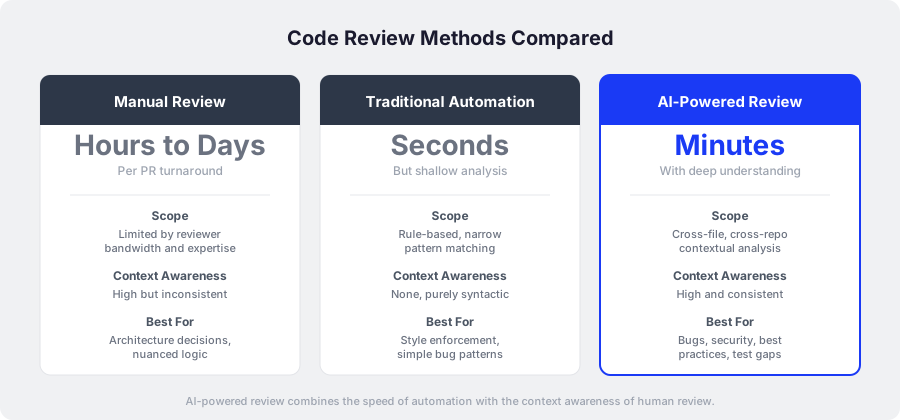
A: Long-running agents persist context and learning across sessions, enabling them to tackle flakiness and edge cases that traditional stateless scripts often miss. They build institutional memory rather than starting from scratch on every run.
Q: What strategies do agents use to stabilize flaky tests?
A: Agents use intelligent retries, self-healing selectors, and adaptive prioritization to automatically repair or isolate flaky tests and ensure stable, reproducible outcomes.
Q: How can organizations prepare infrastructure for agent-based testing?
A: Prioritize deterministic, isolated, production-like test environments alongside strong version control, telemetry, and monitoring to support reliable agent operation.
Q: Why are long-running agents essential in complex testing environments?
A: They continuously track context and adapt to change, surfacing intermittent or rare failures in multi-service, multi-platform systems that short-lived tools overlook. In environments where dozens of services interact, persistence is a necessity.
*References: Qadence, Accelirate, Anthropic, AdwaitX, ThinkSys, Momentic, QA TestLab*
If you want to start using Polarity, check out the docs or check out our videos under news.
*Product research*