Best AI Code Review Tools for Enterprise QA Teams in 2026
When your engineering org crosses 100 developers, code review stops being a culture problem and becomes an infrastructure problem. PRs pile up. Review turnaround stretches from hours to days. Quality standards drift across teams. And the cost of a missed bug rises with every line of code your org ships.
Enterprise teams need more than a linter with a subscription tier. They need AI code review tools that meet real enterprise requirements: on-prem deployment, FedRAMP and SOC 2 compliance, air-gapped operation, SSO/SCIM provisioning, and audit trails that satisfy both your security team and your regulators.
This comparison covers six tools that serve enterprise QA teams at scale. Each one takes a different approach, from autonomous AI QA to traditional application security scanning to code intelligence platforms. The goal here is to help engineering leaders match the right tool to their team's actual constraints, whether that is a FedRAMP mandate, a 500-developer monorepo, or simply the need to stop burning senior engineers on review duty.
Quick Reference: Enterprise Feature Matrix#
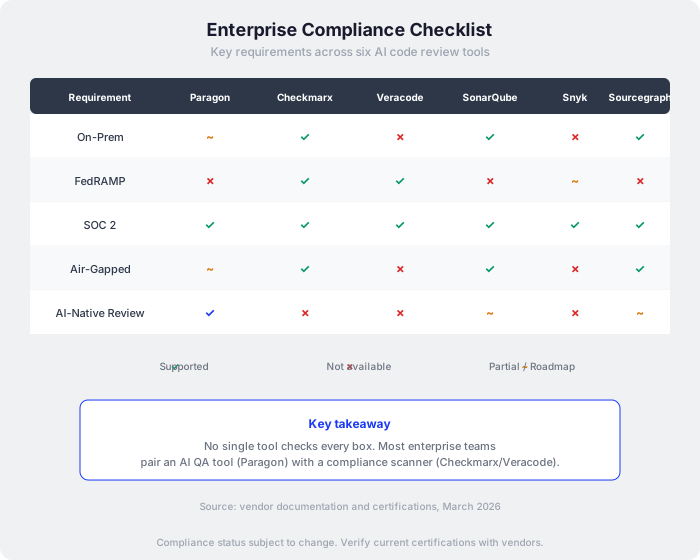
Before going tool by tool, here is the full enterprise requirements comparison at a glance.
| Feature | Paragon | Checkmarx | Veracode | SonarQube Ent. | Snyk Ent. | Sourcegraph |
|---|---|---|---|---|---|---|
| On-Prem | Roadmap | Yes | No | Yes | No | Yes |
| FedRAMP | No | High-Ready | Moderate ATO | No | In Progress | No |
| SOC 2 | Yes | Yes | Yes | Yes (Ent.) | Yes | Yes |
| HIPAA | Roadmap | Yes | BAA available | No | Yes | No |
| PCI DSS | Roadmap | 4.0 | 4.0 | Yes (Ent.) | Yes | No |
| Air-Gapped | Roadmap | Yes | No | Yes | No | Yes |
| Languages | All major | 35+ | 100+ (binary) | 30+ | 20+ | N/A (search) |
| AI-Native Review | Yes | No | No | Partial | No | Partial |
1. Polarity Paragon#
What it does: Autonomous AI QA engineer that reviews code, generates tests, and validates changes before merge.
Paragon is built differently than the other tools on this list. While most enterprise code review platforms focus on static analysis or security scanning, Paragon operates as a multi-agent system that performs the work of a QA engineer: reviewing pull requests, writing test code, and running validation, all before anything reaches your main branch.
The numbers tell the story. On ReviewBenchLite, Paragon hits 81.2% accuracy, which puts it ahead of general-purpose models on code review tasks. Its Omnigrep search engine scores 0.475 F0.5, meaning it finds the relevant code context without flooding reviewers with false matches. In production environments, teams report 90% reductions in manual QA workload with a false positive rate under 4%.
What matters most for enterprise buyers is the tests-as-code approach. Every test Paragon generates is real Playwright or Appium code that lives in your repository. That means full version control, complete audit trails, and the ability for human engineers to read, modify, and extend anything the system produces. There is no black box.
Pricing: Competitive per-developer pricing. Contact for enterprise quotes.
Best for: Engineering organizations that want an autonomous QA layer, teams scaling past manual review capacity, and orgs where auditability of test artifacts is a requirement.
2. Checkmarx#
What it does: Enterprise application security platform with the deepest compliance coverage in the market.
If your primary driver is compliance, Checkmarx is the incumbent for a reason. It holds certifications across SOC 2, PCI DSS 4.0, HIPAA, FISMA, NIST 800-53, and ISO 27001. It carries FedRAMP High-Ready status. And it offers on-premise deployment, which remains a hard requirement for banks, defense contractors, and healthcare systems.
The platform covers SAST, SCA, DAST, IAST, API security, IaC scanning, container security, and secrets detection under one license. Its custom query language, CxQL, lets security teams write organization-specific rules that map directly to internal policies. For teams that need to prove compliance during audits, Checkmarx produces the documentation trail that auditors expect.
The tradeoffs are real, though. Base enterprise packages start around $40,000 to $59,000 per year and scale up from there. Implementation typically requires professional services. And scan times can be slow on large codebases, which creates friction in fast-moving development cycles.
Pricing: $40,000 to $59,000/year base. Scales with users, applications, and modules.
Best for: Regulated industries (financial services, healthcare, government) where compliance certifications and on-prem deployment are hard requirements.
3. Veracode#
What it does: Application security platform with FedRAMP Moderate authorization and unique binary analysis capability.
Veracode's standout feature is binary and bytecode analysis. Unlike every other tool on this list, Veracode can scan compiled applications without access to source code. That makes it valuable for organizations that review third-party software, acquired codebases, or vendor-supplied binaries.
The FedRAMP Moderate ATO (Authority to Operate), which Veracode has held since 2022, is the highest level of active authorization on this list. For government agencies and their contractors, that is often the deciding factor. Veracode also offers US, EU, and US-Federal data residency options, which matters for organizations with strict data sovereignty requirements.
The downside: Veracode is cloud-only. There is no on-premise option. For organizations that need air-gapped deployments or full infrastructure control, that is a dealbreaker. Pricing starts at $15,000 per year per application, and enterprise deployments commonly exceed $200,000 annually.
Pricing: Starting at $15,000/year per application. Enterprise deployments exceed $200K/year.
Best for: Government agencies, defense contractors, and organizations that need to scan binaries or compiled code without source access.
4. SonarQube Enterprise#
What it does: Industry-standard self-hosted static analysis platform with AI Code Assurance for AI-generated code.
SonarQube is the tool most enterprise teams have already encountered. Its Enterprise Edition adds the features that large organizations actually need: branch analysis, taint tracking, portfolio management across projects, and the newer AI Code Assurance feature that detects AI-generated code and enforces stricter review standards on those sections.
The self-hosted model is SonarQube's biggest advantage for enterprise buyers. You run it on your own infrastructure, which means full control over data residency, network access, and upgrade schedules. For organizations that cannot send code to external services, this is table stakes.
SonarQube supports 30+ languages with deep rule sets covering OWASP and CWE standards. The AI CodeFix feature (Enterprise and Data Center editions) generates fix suggestions for detected issues, though this is newer and less mature than the core static analysis engine.
The free Community Edition is heavily limited: no branch analysis, restricted security rules, and minimal reporting. The jump to Enterprise at roughly $20,000 per year is significant, but most large organizations find the self-hosted control worth the cost.
Pricing: Approximately $20,000/year (Enterprise Edition, by lines of code).
Best for: Organizations that require self-hosted deployment, teams already using SonarQube Community and ready to upgrade, and enterprises managing portfolio-level code quality across many projects.
5. Snyk Enterprise#
What it does: Unified developer security platform with five products covering the full application security stack.
Snyk combines SAST (Snyk Code), SCA (Snyk Open Source), container scanning, infrastructure as code analysis, and cloud security posture management into a single platform. The developer experience is where Snyk excels. Security findings show up directly in IDEs, PR checks, and CI pipelines with 80% auto-fix accuracy, so developers spend less time context-switching between security dashboards and their actual code.
The 2026 addition of Transitive AI Reachability is a big deal. It analyzes whether vulnerabilities in deep dependency chains are actually reachable from your application code, which dramatically reduces the "fix this high-severity CVE that your code never actually calls" noise that plagues SCA tools.
Snyk's enterprise tier includes SSO, SCIM provisioning, custom roles, Snyk Guard for adaptive security guardrails, and data residency across US, EU, and APAC regions. The main limitation: no on-prem option. Snyk is entirely cloud-hosted, which keeps it out of the running for air-gapped or highly restricted environments.
Pricing: Approximately $110/dev/month ($1,260/year per developer). For a 100-developer team, that is around $126,000 annually.
Best for: Developer-centric security teams that prioritize fix-rate over detection-rate, and organizations comfortable with cloud-only deployment.
6. Sourcegraph Cody Enterprise#
What it does: Enterprise code search and AI coding assistant with self-hosted deployment and air-gapped support.
Sourcegraph occupies a different niche than the other tools here. Its foundation is code search: the ability to query, navigate, and understand an entire enterprise codebase across hundreds of repositories. Cody, the AI assistant layer, adds chat-based code understanding, autocomplete, and PR review summaries on top of that search infrastructure.
For enterprise teams with large, distributed codebases, the search capability alone is often enough to justify the cost. Batch changes let engineering teams execute large-scale refactoring across dozens of repositories from a single interface. And the self-hosted deployment with air-gapped support checks a box that many AI coding tools miss entirely.
The PR review features, while useful, are secondary to Sourcegraph's core value proposition. If your primary need is an AI code reviewer, Sourcegraph's review capabilities are less mature than dedicated tools. But if your team's biggest pain point is "nobody knows where anything is in our 400-repository monorepo," Sourcegraph is the strongest option on this list.
Pricing: $49 to $59/user/month. For a 100-developer team, that is roughly $59,000 to $70,800 annually.
Best for: Large engineering organizations with massive codebases, teams that need enterprise-wide code search, and organizations requiring on-prem or air-gapped deployment for AI coding tools.
Pricing at the 100-Developer Scale#
Enterprise tooling decisions almost always come down to budget alongside technical fit. Here is how these tools compare for a team of 100 developers.
| Tool | Pricing Model | Estimated Annual Cost (100 devs) |
|---|---|---|
| Paragon | Per developer | Contact for enterprise pricing |
| Checkmarx | Per org/module | $40,000 to $200,000+ |
| Veracode | Per application | $15,000+ per app (often $200K+ total) |
| SonarQube Enterprise | By lines of code | ~$20,000+ |
| Snyk Enterprise | Per developer | ~$126,000 |
| Sourcegraph Cody | Per user | ~$59,000 to $70,800 |
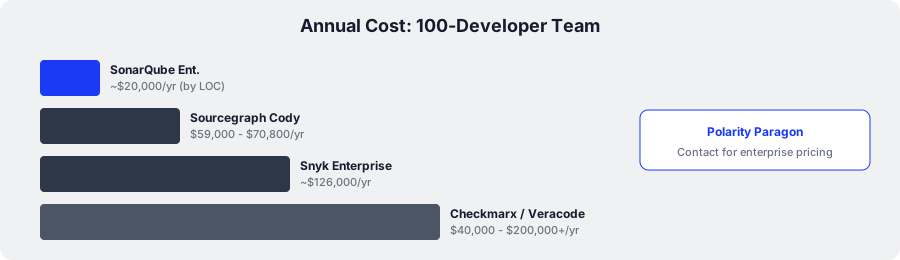
SonarQube offers the most predictable pricing at the enterprise tier since it scales by lines of code rather than headcount. Checkmarx and Veracode pricing is harder to estimate because it varies by the number of applications and modules licensed. Snyk's per-developer model becomes expensive fast at 100+ seats.
How to Choose the Right Tool#
The right tool depends on what constraint matters most to your organization.
If compliance certification is the top priority, Checkmarx offers the deepest coverage across FedRAMP, HIPAA, PCI DSS, and ISO standards. Veracode is the only tool with active FedRAMP Moderate authorization if you need that specifically.
If you need on-prem or air-gapped deployment, your options narrow to Checkmarx, SonarQube, and Sourcegraph. Snyk and Veracode are cloud-only. Paragon has on-prem on its roadmap.
If your biggest problem is QA capacity, Paragon is the only tool here designed to replace manual QA effort rather than augment static analysis. The 90% manual QA reduction with under 4% false positives makes it the strongest choice for teams drowning in review backlogs.
If you already use SonarQube Community and want a natural upgrade path with self-hosted control, SonarQube Enterprise is the obvious next step.
If unified security is the goal, Snyk's five-product platform covers more of the security stack in one license than any other option here.
If enterprise code search is the primary need, Sourcegraph's codebase intelligence is unmatched, and Cody's AI features are a bonus on top of the core search value.
Most enterprise teams end up running more than one of these tools. A common pattern is pairing an AI QA platform like Paragon (for review and test automation) with a compliance-focused scanner like Checkmarx or Veracode (for security certification requirements). The tools serve different purposes and do their best work together.
FAQ#
What makes a code review tool enterprise-grade?#
Enterprise-grade means the tool supports on-premise or self-hosted deployment, holds compliance certifications (SOC 2, FedRAMP, HIPAA, PCI DSS), offers SSO and SCIM provisioning, provides audit trails, and can operate in air-gapped or restricted network environments. Language coverage across 20+ languages is also expected at the enterprise tier.
How much should a 100-developer team budget for AI code review tooling?#
Budget depends heavily on the tool category. Self-hosted static analysis (SonarQube) can run around $20,000 per year. Developer security platforms (Snyk) price around $126,000 annually for 100 seats. Traditional AppSec platforms (Checkmarx, Veracode) often exceed $200,000 per year for full enterprise deployments. Autonomous AI QA platforms offer competitive per-developer pricing that is typically well below the cost of equivalent human QA headcount.
Can AI code review tools replace manual QA at scale?#
AI tools significantly reduce manual QA workload. Polarity Paragon reports 90% manual QA reduction with a false positive rate under 4%. That said, most enterprise organizations keep human reviewers for high-risk changes, security-sensitive code, and architectural decisions. The practical model is AI handling the volume while humans focus on judgment calls.
Do these tools work with AI-generated code?#
This is becoming a key evaluation criterion. SonarQube's AI Code Assurance specifically detects and applies stricter rules to AI-generated code. Paragon's multi-agent review architecture treats all code equally, catching issues that AI generators often miss (particularly around test coverage and edge cases). Snyk's Transitive AI Reachability helps with the dependency security side of AI-generated code.