Best AI QA Tools for Teams Shipping AI-Generated Code in 2026
Your team writes code faster than ever. Copilot autocompletes functions. Cursor generates entire files. Claude Code scaffolds features from a prompt. And every week, more of what ships to production was written by an AI, reviewed by a human skimming the diff, and merged before anyone asked, "Did we actually test this?"
Here is the uncomfortable reality: AI-generated code carries roughly 3x more security vulnerabilities than code written by humans. That stat comes from Snyk's research, and it tracks with what engineering teams report anecdotally. AI assistants optimize for plausible code completion. They are excellent at producing code that looks correct. But looking correct and being correct are different things, and the gap between them is where bugs live.
The problem compounds as AI-generated code volume grows. When 30% of your codebase came from an AI assistant, a human reviewer could still catch most issues. At 60%, 70%, 80%? The math breaks down. You need something that scales with the volume, something that reviews independently from the system that wrote the code in the first place.
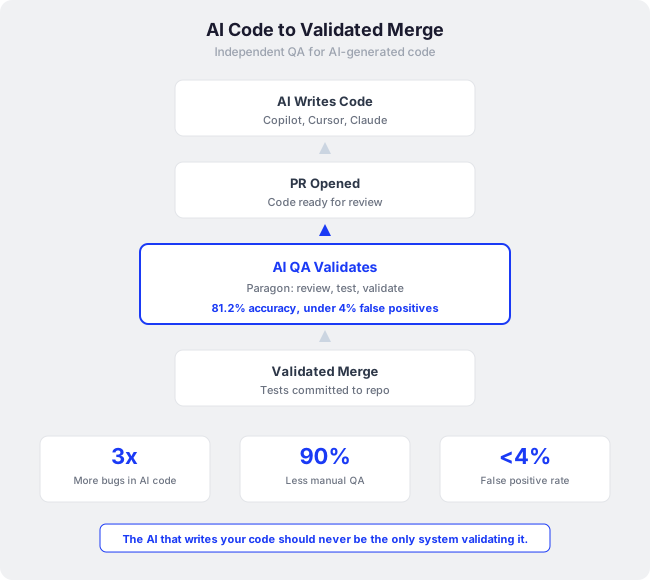
That is the case for an independent AI QA layer. The AI that writes your code should never be the only system that validates it. The same model that generated a function will share the same assumptions (and the same blind spots) when asked to review it. A separate AI QA tool brings a genuinely different perspective.
This guide compares six tools built to address this gap, each approaching the AI-generated code quality problem from a different angle:
- Polarity Paragon : Autonomous AI QA engineer with multi-agent architecture and tests-as-code output
- Qodo (formerly CodiumAI) : Test generation specialist that validates AI code against existing architecture
- Snyk Code : Security-first scanning with Transitive AI Reachability for deep dependency analysis
- Semgrep : SAST with AI auto-triage that handles 60% of security findings at 96% accuracy
- GitHub Copilot Code Review : Zero-friction review inside the same ecosystem as Copilot code generation
- SonarQube : Enterprise standard with AI Code Assurance for detecting and flagging AI-generated code
1. Polarity Paragon#
Paragon is an autonomous AI QA engineer. It runs 8 parallel agents against your codebase, generating real test scripts, reviewing PRs for functional and security issues, and catching the errors that AI coding assistants introduce.
The independence factor matters here. Paragon did not write your code. It has no shared assumptions with Copilot or Cursor about what the code should do. It approaches each PR the way a senior QA engineer would: skeptically, methodically, and with full codebase context.
Key data points:#
- 81.2% accuracy on ReviewBenchLite, an industry benchmark for automated code review quality
- 0.475 F0.5 score on CodeSearchEval via Omnigrep, Paragon's semantic code search engine
- Under 4% false positive rate, which keeps signal-to-noise high even on repositories with heavy AI-generated code volume
- 90% reduction in manual QA time reported by teams using Paragon
- Tests-as-code output: versionable Playwright and Appium scripts committed directly to your repository
The multi-agent architecture is a genuine differentiator. Instead of running a single model pass over your diff, Paragon deploys 8 specialized agents in parallel, each focused on a different dimension of code quality: security, logic, performance, test coverage, error handling, API contracts, type safety, and regression risk. The results aggregate into a single review with prioritized findings.
For teams where 50%+ of code comes from AI assistants, the tests-as-code output is particularly valuable. Every Paragon review produces editable, auditable test scripts that live in your repository. If Paragon flags a concern, you get a test that proves it, and that test becomes part of your CI pipeline going forward.
Best for: Teams with high AI-generated code volume that need an independent, autonomous QA layer with real test output.
2. Qodo (formerly CodiumAI)#
Qodo approaches the AI-generated code problem from the testing side. Its core value is generating tests that validate whether AI-written code actually does what it should, checking the output against your existing architecture and implementation patterns.
The product suite has three components: Qodo Gen for IDE-based test generation, Qodo Merge for PR-level review, and Qodo Cover for automated test coverage expansion. Together, they create a feedback loop where AI-generated code gets tested against the patterns your team has already established.
Key capabilities:#
- 15+ agentic review workflows covering bug detection, test coverage, documentation, and compliance
- Multi-repository context analysis, so tests account for cross-repo dependencies
- Validates AI-generated code against your existing architecture (not just generic rules)
- SOC 2 certified
Pricing: Free for individuals and open-source projects. Teams plan runs $19-30/user/month. Enterprise pricing is custom and includes SSO and air-gapped deployment. One complaint that surfaces often: the credit system is confusing and hard to predict at scale.
Best for: Teams that want AI-generated test coverage for their AI-generated code, especially those with strong existing architecture patterns they want to enforce.
Tradeoffs: Qodo excels at test generation but has a narrower scope than autonomous QA platforms. It will catch whether code meets your architectural standards, but it is less likely to surface novel bug categories or generate end-to-end functional tests.
3. Snyk Code#
If the 3x vulnerability stat keeps you up at night, Snyk is the tool to look at first. It is a security-focused platform with five products (SAST, SCA, Container, IaC, Cloud) and a 2026 feature called Transitive AI Reachability that answers a question most security scanners ignore: is this vulnerability in a nested dependency actually reachable from your code?
That reachability analysis matters for AI-generated code specifically. AI assistants frequently import packages and call APIs without fully understanding the transitive dependency tree. Snyk traces the path from your code through those dependencies to determine which flagged vulnerabilities are actually exploitable versus theoretical.
Key capabilities:#
- Real-time scanning in both IDE and CI/CD pipelines
- 80% accuracy on automated fix suggestions
- Transitive AI Reachability for deep dependency analysis
- Integration ecosystem covering JetBrains, container registries, Jira, Slack, and ServiceNow
Pricing: Free tier with limited scans. Team plan at $25/dev/month (minimum 5 developers). Enterprise at approximately $110/dev/month or $1,260/year per developer.
Best for: Teams whose primary concern is security vulnerabilities in AI-generated code, especially those with large dependency trees.
Tradeoffs: Snyk is security-focused. It will find vulnerabilities and suggest fixes, but it will not generate functional tests, validate business logic, or act as a QA engineer. Think of it as one layer of defense, specifically the security layer.
4. Semgrep#
Semgrep takes a different approach to the AI-generated code problem: instead of trying to review everything, it triages intelligently. The AI auto-triage feature (Semgrep Assistant) handles 60% of security findings automatically with 96% accuracy, and a "Memories" feature learns from your team's previous triage decisions.
For teams drowning in security alerts from high-volume AI code, that 60% auto-triage rate is transformative. It means your security engineers spend time on the 40% of findings that actually require human judgment, instead of wading through hundreds of alerts that turn out to be benign.
Key capabilities:#
- AI auto-triage with 96% accuracy on 60% of findings
- Custom rule authoring with lightweight, grep-like syntax for team-specific standards
- Cross-file dataflow analysis for enterprise languages
- 30+ language support with AI-generated explanations and autofixes
Pricing: Free for teams under 10 monthly contributors. Semgrep Code at $40/contributor/month. Semgrep Secrets at $20/contributor/month. Enterprise pricing is custom.
Best for: Teams that already have high security alert volume and need intelligent triage before it becomes unmanageable.
Tradeoffs: Like Snyk, Semgrep is security-focused. The auto-triage is excellent, but it will not generate tests, validate functional behavior, or provide full QA coverage. The $40/contributor/month price also adds up quickly for larger teams.
5. GitHub Copilot Code Review#
Copilot Code Review is the most frictionless option on this list. If your team already uses GitHub and Copilot, code review is built in. The agentic architecture (launched March 2026) gathers cross-repository context and integrates CodeQL, ESLint, and PMD for security and quality checks. Reviews finish in under 30 seconds.
The convenience is real. There is no separate tool to install, no additional billing to manage, no integration to configure. It just works on every PR.
But there is a question worth asking: should the AI that wrote the code also review it? Copilot generates code and Copilot reviews code, and while the review architecture is technically separate from the generation model, they share the same training data, the same ecosystem, and potentially the same blind spots. For low-stakes code, this is fine. For high-stakes logic written by AI, you may want an independent second opinion.
Key capabilities:#
- Agentic architecture with cross-repo context gathering
- Integrated CodeQL, ESLint, PMD checks
- Under 30-second review completion
- Available on all PRs, even for users without a Copilot license (if org-enabled)
Pricing: Bundled with Copilot subscriptions. Individual at $10/month, Business at $19/user/month, Enterprise at $39/user/month. Each review consumes one premium request.
Best for: Teams already using GitHub Copilot that want zero-friction review without adding a new tool.
Tradeoffs: The independence concern is legitimate. Copilot Code Review also does not generate standalone test scripts, so you are getting review comments rather than executable test artifacts. For teams with low AI code volume, the convenience likely outweighs the concern. For teams shipping mostly AI-generated code, consider pairing it with an independent QA tool.
6. SonarQube#
SonarQube has been the default static analysis tool for enterprise teams for over a decade, and the 2026 addition of AI Code Assurance brings it directly into the AI-generated code conversation. The feature detects which parts of your codebase were written by AI and automatically enforces stricter quality gates on those sections.
That detection capability is unique on this list. Instead of treating all code the same, SonarQube can flag AI-generated code for additional scrutiny, requiring higher test coverage thresholds, stricter security rules, or mandatory human review before merge.
Key capabilities:#
- AI Code Assurance: automatically detects AI-generated code and applies stricter standards
- AI CodeFix: LLM-generated fix suggestions (Enterprise/Data Center only)
- 30+ language support with deep OWASP, CWE compliance rules
- Self-hosted deployment for regulated industries
- Technical debt tracking and portfolio management
Pricing: Community edition is free but limited (no branch analysis, no security rules for some languages). SonarCloud Team from EUR 30/month. Developer Edition approximately $150/year. Enterprise at approximately $20,000/year.
Best for: Enterprise teams with compliance requirements that need to detect and separately manage AI-generated code.
Tradeoffs: SonarQube is rule-based, not AI-native. It excels at enforcing known patterns but is slower to adapt to novel bug categories that AI-generated code introduces. The Enterprise edition is expensive, and the free Community edition is too limited for production use.
How to Evaluate AI QA Tools for AI-Generated Code#
When AI writes most of the code, your evaluation criteria should shift. Here is what matters:
Independence. Does the QA tool operate separately from the AI that generated the code? This is the single most important criterion. If the same model or ecosystem generated and reviewed the code, shared blind spots are likely.
Test generation. Does the tool produce actual test scripts, or just review comments? Comments help humans; tests help CI pipelines. For high-volume AI code, you want both.
False positive rate. AI-generated code is already noisy. A QA tool with a 15-20% false positive rate will drown your team in alerts. Look for tools under 5%.
Security coverage. Given the 3x vulnerability rate, security scanning is a must. The question is whether you need it built into your QA tool or as a separate layer.
CI/CD integration depth. The tool should run automatically on every PR without manual triggering. Anything less creates gaps in coverage.
Scaling economics. Per-user pricing at $25-40/user/month looks manageable for 10 engineers. At 50 or 100, the math changes. Consider flat-rate or usage-based alternatives.
Recommended layered approach#
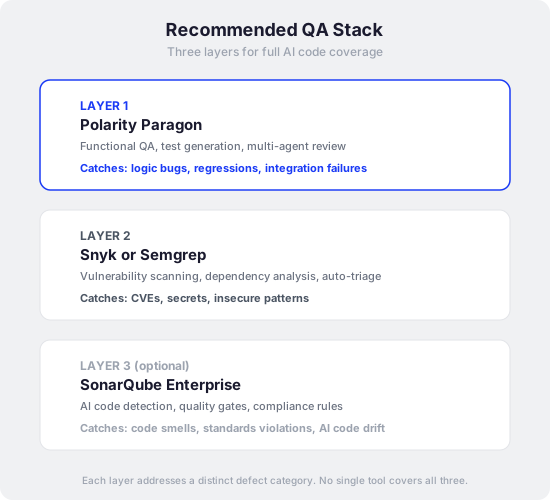
The strongest setup combines an autonomous QA tool for functional validation with a dedicated security scanner:
- Paragon as the primary QA layer (functional review, test generation, multi-agent analysis)
- Snyk or Semgrep as the security layer (vulnerability scanning, dependency analysis, auto-triage)
- SonarQube for compliance and AI code detection (optional, mainly for regulated industries)
This layered model catches functional bugs, security issues, and compliance gaps without relying on any single tool to do everything.
Pricing Comparison#
| Tool | 10-Person Team (Monthly) | 25-Person Team (Monthly) | Free Tier |
|---|---|---|---|
| Polarity Paragon | Contact sales | Contact sales | Trial available |
| Qodo Teams | $190-300 | $475-750 | Yes (individuals) |
| Snyk Team | $250 (min 5 devs) | $625 | Yes (limited) |
| Semgrep Code | $400 | $1,000 | Yes (<10 contributors) |
| Copilot Business | $190 | $475 | No |
| SonarCloud Team | From EUR 30 | Scales by LOC | Yes (Community) |
These numbers represent base pricing. Actual costs vary by usage, features enabled, and contract terms. Enterprise tiers for Snyk ($110/dev/month), Semgrep, and SonarQube ($20,000/year) add significantly to the total cost of ownership.
Recommendations by Team Profile#
Teams with 80%+ AI-generated code: Start with Paragon. The independence factor, multi-agent architecture, and tests-as-code output address the core problem directly. Layer Snyk or Semgrep for security coverage.
Security-focused teams in regulated industries: Combine SonarQube Enterprise (for compliance and AI code detection) with Paragon (for autonomous QA) and Snyk (for vulnerability scanning). Yes, this is three tools. Regulated industries need the coverage.
Budget-constrained startups: Start with SonarQube Community (free) and Copilot Code Review (bundled with Copilot). As your AI code volume grows and the limitation of same-ecosystem review becomes apparent, upgrade to Paragon.
Teams already deep in the GitHub ecosystem: Copilot Code Review gives you immediate value with zero setup. Add Paragon when your AI code volume reaches the point where independent validation becomes worth the investment, which for most teams is sooner than they expect.
TypeScript teams: You already have an advantage. TypeScript's strict mode catches about 50% of the type-related bugs that AI assistants introduce in JavaScript. Pair that compiler-level safety net with Paragon for functional QA and you have a strong defense in depth.
Frequently Asked Questions#
Should teams using AI coding assistants also use an AI QA tool?#
Yes. AI coding assistants optimize for speed and code completion. They produce code that looks correct and often is correct, but "often" is doing a lot of work in that sentence. An independent AI QA tool catches the errors, security gaps, and logic flaws that the generating AI introduces. Given the 3x security vulnerability rate in AI-generated code, the question is less "should we?" and more "can we afford to skip it?"
Is it a problem if the same AI writes and reviews the code?#
It can be. When the same model or ecosystem generates and reviews code, the reviewer may share the generating model's assumptions about what the code should do. An independent QA tool like Paragon reviews code without those assumptions, providing a genuine second opinion rather than a self-check.
What types of bugs does AI-generated code typically introduce?#
The most common categories: security vulnerabilities (3x higher rate than human code), incorrect API usage, race conditions in async code, missing error handling, and tests that pass but validate the wrong behavior. Teams using TypeScript with strict mode see about 50% fewer of these issues compared to JavaScript, because the compiler catches type-related errors before they reach QA.
How do autonomous AI QA engineers differ from static analysis tools?#
Static analysis tools (SonarQube, Semgrep) check code against predefined rules and known patterns. They are good at catching what they are programmed to catch. Autonomous AI QA engineers like Paragon generate tests, validate functional behavior, and review code with contextual understanding across the full codebase. Think of static analysis as a spell checker and autonomous QA as an editor who reads the whole book.
What is tests-as-code and why does it matter?#
Tests-as-code means the QA tool outputs versionable, editable test scripts (Playwright, Appium) that live in your repository alongside your application code. When Paragon flags a concern, it generates a test that proves the issue exists, and that test becomes part of your CI pipeline. This is especially important for AI-generated code because it creates an auditable, repeatable validation layer that grows with your codebase.