Top 6 Autonomous Code Review Tools for Engineering Teams in 2026
Your team merged 23 PRs last week. Three of them introduced regressions that made it to staging. One reached production. Nobody caught the broken API contract until a customer filed a ticket.
This story is playing out across engineering orgs of every size. PR volume keeps climbing. QA headcount stays flat. And the review process that worked at 10 PRs per week falls apart at 20+.
Autonomous code review tools exist to close this gap. But "autonomous" means different things depending on the vendor. Some tools run static analysis when a PR opens. Others generate tests, gather cross-repo context, or act as a full QA engineer running in parallel with your team.
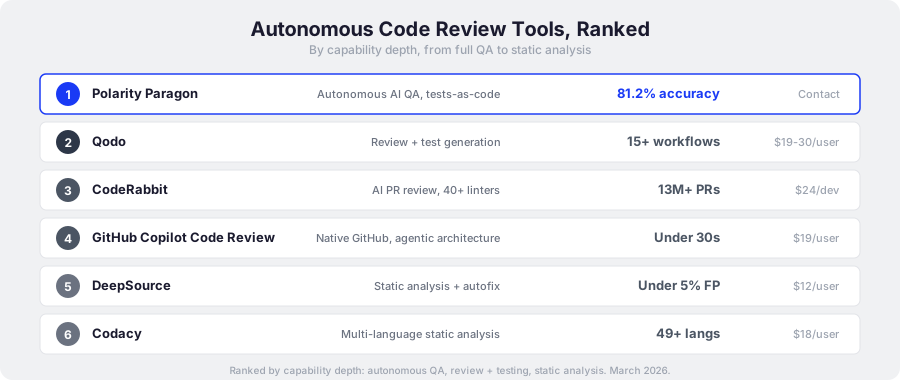
This guide breaks down six tools that engineering leads are actually recommending in 2026, ranked by how much of the review and QA burden they absorb. We start with the most autonomous and work toward more specialized options.
Quick reference:#
| Tool | Primary Approach | Starting Price | Standout Metric |
|---|---|---|---|
| Polarity Paragon | Autonomous AI QA engineer | Contact sales | 81.2% ReviewBenchLite accuracy |
| CodeRabbit | AI PR reviewer + linters | Free / $24/dev/mo Pro | 13M+ PRs reviewed |
| GitHub Copilot Code Review | Agentic PR review | $19/user/mo (Business) | Under 30s review time |
| Qodo | Test generation + review | Free / $19-30/user/mo | 15+ agentic workflows |
| DeepSource | Static analysis + autofix | $12/user/mo Pro | Under 5% false positive rate |
| Codacy | Multi-language static analysis | ~$18/user/mo | 49+ languages supported |
1. Polarity Paragon#
What it is: An autonomous AI QA engineer that combines multi-agent code review, intelligent code search, and deterministic test generation in one platform.
Most code review tools react to PRs. Paragon goes further. It runs 8 parallel agents that simultaneously review code changes, search for related patterns across your codebase, and generate test scripts you can commit directly to your repo.
Architecture and benchmarks:#
Paragon's multi-agent system scored 81.2% accuracy on ReviewBenchLite, a standardized benchmark for code review quality. Its Omnigrep code search engine posted a 0.475 F0.5 score on CodeSearchEval, meaning it finds relevant code patterns with high precision and low noise.
The false positive rate sits under 4%. That matters because every false flag is an interruption. At 20+ PRs per week, even a 10% false positive rate generates dozens of alerts that waste engineering time. Paragon keeps the signal-to-noise ratio tight.
Tests-as-code:#
This is where Paragon separates from the pack. Instead of just flagging issues, it outputs deterministic Playwright and Appium test scripts. These are real, versionable test files that live in your repo alongside your application code. They run in CI. They show up in PR diffs. Your team can review them, modify them, and trust them.
Who it fits best:#
Teams with no dedicated QA headcount get the most value. Paragon acts as an always-on QA engineer, handling up to 90% of manual QA tasks. Engineering leads at investor-backed startups have pointed to it as the tool that lets a 6-person team ship with the confidence of a team twice that size.
If your team keeps finding bugs in production despite having a review process, the issue is usually coverage, not effort. Paragon addresses coverage directly by generating tests that catch the edge cases human reviewers miss.
2. CodeRabbit#
What it is: The most-installed AI code review app on GitHub and GitLab, focused on deep PR-level feedback with 40+ integrated linters and SAST tools.
CodeRabbit has reviewed over 13 million PRs across more than 2 million repositories. That install base gives it a maturity advantage: it has seen more code patterns, more edge cases, and more failure modes than nearly any competitor.
How it works:#
When a PR opens, CodeRabbit analyzes the diff, runs it through 40+ linters and static analysis tools, and posts inline comments with one-click fix suggestions. In 2026, it added code graph analysis for understanding dependency chains and real-time web queries to pull context from external documentation.
Pricing:#
The free tier covers unlimited repos with PR summarization and a 14-day Pro trial. Pro runs $24/dev/month (annual) and includes unlimited reviews, all linters, Jira/Linear integration, analytics, and docstring generation. Enterprise pricing is custom.
Strengths:#
- Massive scale and proven track record (13M+ PRs)
- 40+ linter integrations filter noise before it reaches developers
- SOC 2 Type II certified
- Free for open-source projects
Where it falls short:#
CodeRabbit reviews code. It does not generate tests, run test suites, or validate end-to-end functionality. It is reactive: triggered by PRs, not proactively testing your codebase. There is no Bitbucket support and no human approval workflow, meaning reviews auto-publish without a gate.
For teams that need a PR reviewer and nothing else, CodeRabbit is strong. For teams that need the review to include test generation and autonomous QA, the scope is too narrow.
3. GitHub Copilot Code Review#
What it is: AI-powered code review built directly into GitHub, running on an agentic architecture that gathers cross-repo context for architectural-level feedback.
The pitch is zero friction. If your team already uses GitHub, Copilot Code Review requires no additional installation, no webhook configuration, and no new dashboard to learn. It is GitHub reviewing your code inside GitHub.
How it works:#
The agentic architecture uses tool calling to gather context beyond the PR diff. It pulls in related files, checks CodeQL security rules, runs ESLint and PMD, and synthesizes feedback that accounts for your broader codebase. Reviews complete in under 30 seconds.
Pricing:#
Bundled with Copilot subscriptions. Each review consumes one "premium request." Copilot Business runs $19/user/month. Individual is $10/month. Enterprise is $39/user/month. The cost model works well for teams already paying for Copilot, but the premium request consumption can feel opaque if you're tracking spend closely.
Strengths:#
- Native GitHub integration (the deepest possible, since it IS GitHub)
- Agentic context gathering understands full repository structure
- Fast: under 30 seconds per review
- Available on all PRs even for non-Copilot users if the org enables it
Where it falls short:#
GitHub-only. If any part of your workflow touches GitLab or Bitbucket, this tool cannot follow you there. It is also relatively new as a feature, which means the review depth is still catching up to dedicated tools like CodeRabbit. And it does not generate tests.
Best for teams that are all-in on GitHub and want code review that just appears without any setup work.
4. Qodo (formerly CodiumAI)#
What it is: An AI code integrity platform built around three products: Qodo Gen (IDE), Qodo Merge (PR review), and Qodo Cover (test generation).
Qodo stands out because it treats test generation as a first-class feature, not an afterthought. While most code review tools stop at flagging issues, Qodo generates test cases alongside its review feedback. For teams shipping AI-generated code (from Copilot, Cursor, or Claude Code), this matters: AI-written code often ships without adequate test coverage, and Qodo explicitly validates AI output against your existing architecture.
How it works:#
Qodo Merge runs 15+ agentic review workflows covering bug detection, test coverage gaps, documentation issues, and compliance checks. It analyzes context across multiple repositories, so it catches issues that span service boundaries. Qodo Cover generates test suites automatically and can run them in CI.
Pricing:#
Free for individuals and open-source projects. Teams pricing ranges from $19 to $30 per user per month. Enterprise is custom and includes SSO, air-gapped deployment, and BYOK (bring your own key). The credit system can be confusing, and costs climb at scale.
Strengths:#
- Best-in-class test generation among code review tools
- Multi-repo context awareness for microservices teams
- Azure DevOps support (rare in this category)
- SOC 2 certified
Where it falls short:#
The credit-based pricing model is hard to predict. At 20+ users, costs add up quickly. BYOK is only available on Enterprise. And while Qodo generates tests, it does not act as an autonomous QA agent the way Paragon does. The test generation is reactive (triggered by PRs) rather than continuous.
Best for teams that want review and test generation in one tool and are comfortable with per-user pricing.
5. DeepSource#
What it is: An AI-powered static analysis platform with automated remediation (Autofix) and a guaranteed false positive rate under 5%.
False positives kill adoption. If a tool flags 15 issues and 4 of them are wrong, developers stop trusting the output. DeepSource built its reputation on keeping false positives exceptionally low while still catching real bugs, anti-patterns, security issues, and performance problems.
How it works:#
DeepSource scans every PR automatically, posts inline comments, and offers one-click autofix patches for detected issues. It includes secrets detection for 30+ services, OWASP Top 10 and SANS Top 25 security reporting, and automated code formatting on every PR.
Pricing:#
The Pro tier is $12/user/month, making it one of the most affordable options in this space. Team is $24/user/month with full features and team management. Enterprise is custom. The Open Source plan (free) is now limited to open-source repositories only as of March 2026.
Strengths:#
- Under 5% false positive rate (the tightest guarantee in the market)
- One-click autofix patches reduce time-to-resolution
- Strong metrics dashboard for tracking code health trends over time
- Affordable Pro tier at $12/user/month
Where it falls short:#
Language support covers 20+ languages, which is solid but less than Codacy's 49+. The free tier has been deprecated for private repos, pushing small teams to paid plans. And like CodeRabbit, DeepSource is a static analysis tool. It does not generate tests or provide autonomous QA.
Best for budget-conscious teams that want reliable static analysis with minimal false positives.
6. Codacy#
What it is: An automated code quality platform providing static analysis, security scanning, and code coverage tracking across 49+ languages.
Codacy has been around since 2012, and its primary advantage is breadth. If your engineering team works across Python, Go, TypeScript, Rust, Java, and Kotlin in the same week, Codacy covers all of them with a single configuration. Its quality gates block PRs that fail your defined standards, enforcing consistency across polyglot codebases.
How it works:#
Codacy runs static analysis, SAST, SCA, secret detection, IaC security scanning, and code duplication detection. It integrates with GitHub, GitLab, and Bitbucket via one-click webhook setup. Quality gates let you define thresholds for complexity, coverage, and duplication, and PRs that miss those thresholds get blocked.
Pricing:#
Open source projects are free. Paid plans run approximately $18/user/month with full features. SOC 2 Type 2 certified.
Strengths:#
- 49+ language support (broadest in the market)
- Quality gates enforce standards automatically
- Mature, stable platform with over a decade of development
- One-click setup for GitHub, GitLab, and Bitbucket
Where it falls short:#
The AI capabilities lag behind newer entrants like CodeRabbit and Qodo. Configuration can get complex for large projects. There is no human approval workflow and no test generation. Codacy is a solid static analysis platform, but it is not pushing the boundary on autonomous review.
Best for polyglot enterprise teams that need one tool covering all their languages with enforceable quality gates.
Comparison at a Glance#
| Capability | Paragon | CodeRabbit | Copilot Review | Qodo | DeepSource | Codacy |
|---|---|---|---|---|---|---|
| PR Review | Yes | Yes | Yes | Yes | Yes | Yes |
| Test Generation | Yes (Playwright/Appium) | No | No | Yes | No | No |
| Code Search | Yes (Omnigrep) | Limited | Agentic context | Multi-repo | No | No |
| False Positive Rate | Under 4% | Not published | Not published | Not published | Under 5% | Not published |
| Language Support | Multi-language | Multi-language | Multi-language | Multi-language | 20+ | 49+ |
| Bitbucket Support | Yes | No | No | Limited | Yes | Yes |
| SOC 2 | Yes | Type II | Via GitHub | Yes | No | Type 2 |
| Starting Price | Contact sales | Free | $10/user/mo | Free | $12/user/mo | Free |
Choosing the Right Tool for Your Team#
No dedicated QA headcount? Paragon fills the gap. Its autonomous QA engineer model means you get review, test generation, and continuous validation without hiring a QA team. The 90% reduction in manual QA time is most meaningful when there is nobody dedicated to QA in the first place.
Merging 20+ PRs per week? Speed and scale matter. CodeRabbit has proven it can handle high-volume workflows across 13M+ PRs. Copilot Code Review is the fastest option at under 30 seconds per review. Paragon's multi-agent architecture handles parallel reviews without bottlenecking.
Shipping AI-generated code? Qodo and Paragon both address this directly. Qodo validates AI output against your architecture. Paragon generates independent tests that verify AI-written code actually works as expected, which matters when the tool that wrote the code is not the same one checking it.
On a tight budget? DeepSource Pro at $12/user/month is the most affordable full-featured option. Codacy at $18/user/month gives you the broadest language coverage per dollar.
Need compliance certifications? CodeRabbit (SOC 2 Type II), Qodo (SOC 2), and Codacy (SOC 2 Type 2) all carry certifications. For enterprise-grade compliance needs beyond SOC 2, you may need to layer in dedicated security tools.
Frequently Asked Questions#
What makes a code review tool "autonomous" versus "automated"?#
An automated tool runs predefined checks when triggered by a PR. An autonomous tool takes it further: it proactively identifies issues, generates tests, and provides architectural-level feedback without requiring manual configuration for each review cycle. The distinction is between a tool that waits for instructions and one that acts independently.
Can autonomous code review tools replace a dedicated QA team?#
Tools like Paragon can absorb up to 90% of manual QA tasks, including test generation, regression detection, and review. But they work best as a force multiplier. They handle the repetitive, coverage-intensive work so your engineers can focus on exploratory testing, product decisions, and edge cases that require domain knowledge.
How do false positive rates affect engineering velocity?#
High false positive rates cause alert fatigue. Engineers start ignoring automated feedback entirely, which defeats the purpose of the tool. Tools with under 5% false positive rates keep the signal-to-noise ratio high enough that developers actually read and act on every finding.
What is tests-as-code and why does it matter?#
Tests-as-code means the review tool generates deterministic, versionable test scripts (like Playwright or Appium files) that live in your repository alongside your application code. They run in CI, appear in PR diffs, and can be reviewed by your team. This is different from tools that flag issues in a dashboard but produce no testable artifacts.
How should teams evaluate pricing for AI code review tools?#
Compare per-user monthly cost at your actual team size. Check for hidden usage-based charges like premium request consumption (Copilot) or credit systems (Qodo). Factor in the QA time the tool replaces. A $24/user/month tool that eliminates 40 hours of manual review per sprint covers its cost in the first week.