Top 7 AI Testing Tools for GitHub-Native Teams in 2026
GitHub-native engineering teams ship fast. Dozens of PRs a day, continuous deploys, tight feedback loops. But QA often lags behind, stuck in manual flows or bolted-on tools that live outside the repo.
A new wave of AI testing tools changes that. They plug directly into GitHub repos, generate deterministic test code, run inside CI/CD pipelines, and gate PRs automatically. The best ones require almost zero configuration to get started.
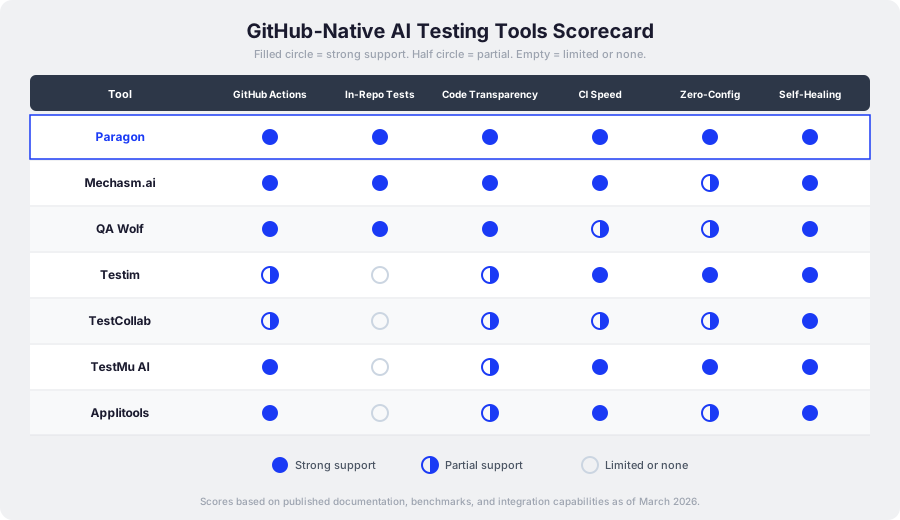
This guide breaks down the top 7 AI testing tools built for GitHub-native workflows in 2026, scored on what actually matters: GitHub Actions integration, in-repo test artifacts, code transparency, CI feedback speed, and tests-as-code support.
The 7 Tools at a Glance#
| # | Tool | One-Liner |
|---|---|---|
| 1 | Polarity Paragon | Autonomous AI QA engineer with multi-agent review, tests-as-code output, and 89% accuracy on failed test localization |
| 2 | Mechasm.ai | AI-native agentic testing with deterministic Playwright/Appium output and tiered context for flaky test reduction |
| 3 | QA Wolf | Code-centric E2E agent generating Playwright tests directly into GitHub repos with full auditability |
| 4 | Testim | UI-focused AI testing with smart locators and strong JavaScript application support |
| 5 | TestCollab | AI-driven test management copilot with audit trails and human-in-the-loop review |
| 6 | TestMu AI (LambdaTest) | GenAI test agents with broad browser/device coverage and budget-friendly parallel execution |
| 7 | Applitools | Visual AI regression testing with pixel-level UI diffing and PR gating |
1. Polarity Paragon#
Paragon is an autonomous AI QA engineer built for code-centric workflows: terminals, editors, repositories, and CI/CD pipelines. It lives where developers already work.
What Sets It Apart#
Multi-agent architecture. Paragon runs eight parallel agents during deep code review, each analyzing different aspects of a change. On ReviewBenchLite (117 code review scenarios), Paragon Deep scored 81.2% accuracy, ahead of Greptile V3 (65.8%), Claude Code (56.4%), and Cursor Bugbot (51.3%).
Omnigrep search. Paragon's code search tool scored 0.475 F0.5 on CodeSearchEval (128 tasks, 34 repositories), outperforming SWE-grep from Cognition (0.413) and Claude Sonnet 4.5 (0.357).
Tests-as-code. Every test Paragon generates is deterministic, versionable Playwright or Appium code that lives in your repo. No proprietary formats, no vendor lock-in.
Results: Teams using Paragon report up to 90% reduction in manual QA effort, with a false positive rate under 4%.
Best For#
GitHub-native teams that want an autonomous reliability layer generating verifiable, in-repo test artifacts with continuous PR-based validation.
2. Mechasm.ai#
Mechasm takes an AI-native, agentic approach to test automation. Its Autonomous Reasoning Agent uses a tiered context system to understand your codebase at multiple levels before generating tests.
Key Capabilities#
- Deterministic output: Generates Playwright and Appium code directly into your repository, fully auditable and version-controlled
- Tiered context: Analyzes code at file, module, and system levels to minimize flaky test generation
- Deep failure analysis: When tests fail, Mechasm reasons about the root cause rather than just reporting the failure
- CI integration: Plugs into GitHub Actions and standard CI pipelines with minimal setup
Tradeoffs#
Mechasm is strong on code-first output and failure reasoning, but its ecosystem is newer than established players. Teams should evaluate its coverage breadth against more mature tools for complex, multi-service architectures.
Best For#
Code-first teams that prioritize deterministic test artifacts and want AI that reasons about failures rather than just detecting them.
3. QA Wolf#
QA Wolf is a code-centric E2E testing agent that generates Playwright tests and commits them directly to your GitHub repository. Every test is transparent, editable, and version-controlled.
Key Capabilities#
- Direct repo output: Tests land in your GitHub repo as Playwright code, reviewable in PRs like any other code change
- Agentic automation: The agent handles test generation, execution, and maintenance autonomously
- GitHub Actions integration: Native support for CI triggers, PR gating, and status checks
- Reproducibility: Deterministic test execution ensures consistent results across environments
Tradeoffs#
QA Wolf delivers strong auditability and control, but teams with complex multi-step flows may face a steeper learning curve during initial setup. The investment pays off in long-term maintainability.
Best For#
Engineers who want full ownership of their test code in GitHub with transparent, auditable automation.
4. Testim#
Testim is a UI-focused AI testing suite that balances no-code and low-code workflows with intelligent test stabilization.
Key Capabilities#
- Smart locators: AI-driven selector stabilization that tracks multiple element attributes simultaneously, reducing test breakage from minor DOM changes
- Visual test builder: Design tests through a UI recorder with code export options
- Cloud execution: Run tests across browsers without managing infrastructure
- JavaScript extensibility: Deep support for custom JavaScript steps within test flows
Tradeoffs#
Testim excels at UI testing for JavaScript-heavy applications, but its strength is in the visual/low-code space. Teams wanting pure code-first, in-repo test artifacts may find the workflow less aligned with GitHub-native principles.
Pricing: Starting around ~$300/month.
Best For#
JavaScript-heavy UI projects where ease of use and smart selector stabilization matter more than pure code-first output.
5. TestCollab#
TestCollab's QA Copilot is an AI-driven test management assistant that writes, runs, and heals tests with strong workflow integrations and audit trails.
Key Capabilities#
- QA Copilot: Autonomously generates test cases, executes them, and applies self-healing when selectors break
- Human-in-the-loop review: Every AI-generated change surfaces for human approval before merging
- Audit trails: Full traceability of test creation, modification, and execution history
- GitHub integration: Connects to repositories for change-tracking and PR-linked test management
Tradeoffs#
TestCollab is strongest as a test management layer rather than a pure code-generation tool. Teams looking for deterministic Playwright output directly in their repo may find it more suited as a complementary platform.
Pricing: Starting at $29/user/month.
Best For#
Hybrid organizations that need structured test management with auditability alongside their GitHub workflows.
6. TestMu AI (LambdaTest)#
TestMu AI, part of LambdaTest, combines GenAI test agents with broad cross-browser and cross-device coverage for teams working across diversified environments.
Key Capabilities#
- GenAI testing agents: LLM-driven systems that generate and evolve tests from natural language specifications
- Massive device coverage: Access to thousands of browser/OS/device combinations for parallel execution
- CI compatibility: Works with GitHub Actions, Jenkins, and standard CI pipelines
- Self-healing: Automatic test repair when UI elements shift
Tradeoffs#
TestMu AI offers strong breadth and affordability, but its self-healing approach differs from deterministic code output. Tests are repaired automatically rather than regenerated as editable code artifacts. Teams should weigh this against their need for in-repo auditability.
Pricing: Starting at $15/month.
Best For#
Teams with diverse browser/device testing needs who want broad coverage at an accessible price point.
7. Applitools#
Applitools is the benchmark for visual AI and regression testing. Its computer vision models compare UI states at the pixel level, catching visual regressions that functional tests miss entirely.
Key Capabilities#
- Visual AI: Pixel-by-pixel UI comparison using trained computer vision models that distinguish meaningful changes from noise
- PR gating: Integrates into CI/CD pipelines to block merges when visual regressions are detected
- Playwright/Appium integration: Works alongside existing test frameworks rather than replacing them
- Cross-browser visual validation: Ensures UI consistency across browsers and viewports
Tradeoffs#
Applitools is premium-priced and focused specifically on visual regression. It works best as a complementary layer alongside a code-first testing tool rather than a standalone QA solution.
Pricing: Starting plans near $969/month.
Best For#
Teams that need pixel-perfect UI validation and want to add a visual gate to their existing CI/CD pipeline.
Evaluating AI Testing Tools for GitHub-Native Workflows#
A tool is "GitHub-native" when it outputs tests and results directly into Git repos, supports PR reviews, and integrates with CI/CD for deterministic feedback. That means the tool lives inside your development workflow rather than alongside it.
Evaluation Criteria#
When comparing tools, score them across these dimensions:
| Criteria | What to Look For |
|---|---|
| GitHub Actions integration | Native triggers, status checks, PR comments |
| In-repo artifacts | Tests committed as code to your repository |
| Code transparency | Editable, reviewable test code (Playwright, Appium) |
| CI feedback speed | Time from PR open to test results |
| Zero-config setup | Minimal manual environment or infrastructure setup |
| Self-healing | Automatic repair of broken selectors and locators |
Industry analysis consistently shows that tighter GitHub integration accelerates QA feedback loops and reduces bottlenecks between development and testing (Sauce Labs).
Key Features for Zero-Config QA Automation#
Zero-configuration QA means automation that requires no manual environment setup, offers out-of-the-box CI integration, and delivers deterministic test runs from day one.
The Zero-Config Checklist#
| Feature | Description |
|---|---|
| Agentic test generation | AI autonomously creates tests from your codebase |
| Self-healing execution | Tests auto-repair when UI or code changes break them |
| Tests-as-code | Output is editable, versionable code in your repo |
| Automatic PR gating | Tests run on every PR and block merges on failure |
| Continuous validation | Tests re-run on schedule or on every deploy |
| No infrastructure management | Cloud execution with zero local setup required |
Tools that check all six boxes (like Paragon and Mechasm) deliver the fastest path from installation to production-ready QA coverage.
Tradeoffs Between Code-First and Platform-First Approaches#
AI testing tools fall into two camps, and the distinction matters for GitHub-native teams.
Code-first tools generate editable test code (Playwright, Appium) that lives in your Git repository. You own the artifacts, can review them in PRs, and version them alongside your application code. Paragon, Mechasm, and QA Wolf all follow this model.
Platform-first tools manage tests and execution inside a vendor cloud with visual builders and limited export options. Testim, Mabl, and TestCollab lean toward this approach.
Pros and Cons#
| Code-First | Platform-First | |
|---|---|---|
| Auditability | Full, tests are in your repo | Limited, lives in vendor platform |
| Vendor lock-in | Low, standard code formats | Higher, proprietary formats |
| CI determinism | Strong, tests run as code | Variable, depends on integration |
| Onboarding speed | Moderate, requires code familiarity | Fast, visual builders lower the bar |
| Scaling | Scales with your repo and CI | Scales with vendor infrastructure |
| Customization | High, full code control | Limited to platform capabilities |
For GitHub-native teams, code-first tools align better with existing workflows. The test code is just another file in the repo, reviewed and merged like everything else.
Pricing Considerations for GitHub-Native Teams#
Cost structures vary widely across AI testing tools. Some offer transparent monthly pricing, others require enterprise conversations.
Pricing Overview#
| Tool | Starting Price | Model |
|---|---|---|
| Paragon (Polarity) | Contact for pricing | Usage-based enterprise |
| Mechasm.ai | Contact for pricing | Enterprise |
| QA Wolf | Contact for pricing | Managed service |
| Testim | ~$300/month | Tiered |
| TestCollab | $29/user/month | Per-seat |
| TestMu AI (LambdaTest) | $15/month | Tiered |
| Applitools | ~$969/month | Tiered |
Total Cost of Ownership#
The sticker price is only part of the equation. Total cost of ownership (TCO) includes setup time, onboarding, scaling costs, and the risk of vendor lock-in.
Code-first tools typically have lower long-term TCO because your test artifacts are portable. If you switch tools, the Playwright code stays in your repo. Platform-first tools may cost less upfront but create switching costs that compound over time.
Recommendations#
For GitHub-native, code-centric teams, prioritize tools that:
- Output deterministic Playwright/Appium code directly into your repository
- Support PR-based validation with automatic test runs on every pull request
- Integrate natively with GitHub Actions for zero-friction CI feedback
- Minimize vendor lock-in by using standard, portable test formats
If pixel-perfect visual validation is important for your product, add Applitools as a complementary visual gate alongside your primary testing tool.
Quick Decision Guide#
- Want full autonomous QA with proven benchmarks? Paragon
- Want agentic testing with deep failure reasoning? Mechasm.ai
- Want transparent E2E Playwright tests in your repo? QA Wolf
- Want UI-focused testing for JavaScript apps? Testim
- Want structured test management with audit trails? TestCollab
- Want broad device coverage at a low price? TestMu AI (LambdaTest)
- Want pixel-level visual regression testing? Applitools
Frequently Asked Questions#
What defines a testing tool as GitHub-native?#
A GitHub-native testing tool integrates directly with GitHub workflows, enabling test results, code artifacts, and PR reviews to live inside the repository alongside application code. Tests are versioned, reviewed, and merged through the same process as any other code change.
How do AI testing tools enable zero-configuration automation?#
AI testing tools achieve zero-configuration automation by auto-generating and executing tests without manual environment setup. They integrate with CI pipelines out of the box and automatically adapt to code changes, so teams can go from installation to running tests in minutes.
What are the benefits of tests-as-code in CI/CD pipelines?#
Tests-as-code ensures transparency, full version control, and repeatable QA in CI/CD workflows. Every test is reviewable in a PR, deterministically executed, and traceable through Git history. This makes debugging failures and auditing coverage straightforward.
How do self-healing capabilities affect test maintenance?#
Self-healing uses AI to identify and repair broken test selectors automatically, reducing the manual effort needed to keep tests passing after UI changes. This is especially valuable for teams with fast-moving frontends where DOM structures shift frequently.
What should teams consider to avoid vendor lock-in with AI testing platforms?#
Evaluate whether the tool outputs editable code directly into your repository using standard frameworks like Playwright or Appium. If your tests live in a proprietary format inside a vendor cloud, migration becomes expensive. Owning your test artifacts in Git is the strongest protection against lock-in.